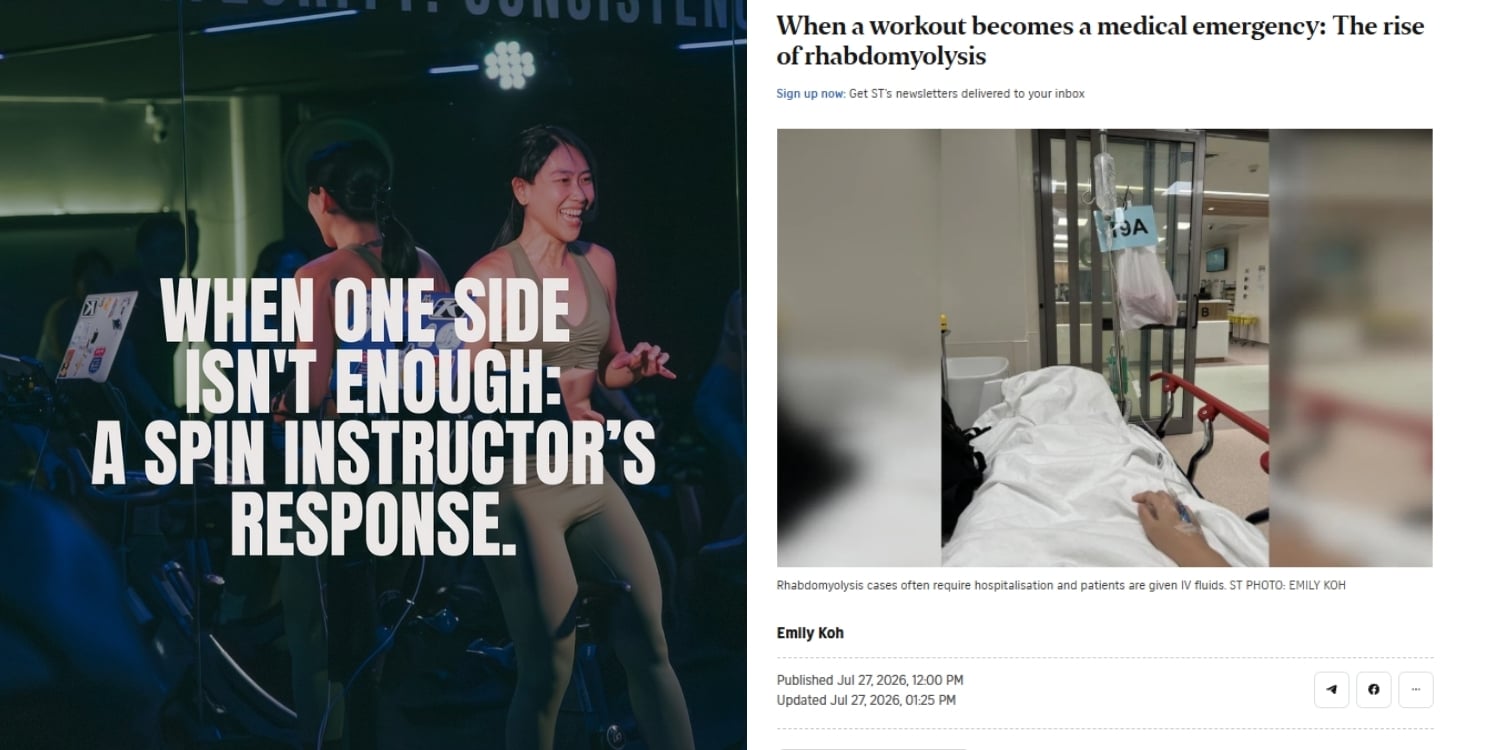

Risk around rhabdomyolysis: Local spin instructors and netizens say ‘stop blaming spin classes’
A recent The Straits Times (ST) article about rhabdomyolysis, a potentially serious condition caused by muscle breakdown, has sparked backlash from members of Singapore’s spin community.
Several spin instructors and studio owners felt the piece presented an unbalanced picture of indoor cycling by focusing on severe cases without highlighting the industry’s safety practices.
Source: Revolution website
ST reporter shared her own experience with rhabdomyolysis
Published on Monday (27 July), the ST article centred on a journalist’s experience after attending her first spin class.
She recounted developing severe muscle pain days later before being diagnosed with rhabdomyolysis and hospitalised for three days.
The article also cited hospital data showing an increase in rhabdomyolysis cases, with doctors noting that first-time spin participants accounted for many spin-related cases.
Medical experts interviewed stressed that the condition is not exclusive to spin, and can also result from activities such as weightlifting, CrossFit, military training, marathon running and other high-intensity exercise.
They advised people to increase workout intensity gradually, stay hydrated and stop exercising if they experience excessive pain or fatigue.
Spin instructor responds, labelling article as ‘gutter journalism’
The article drew criticism from spin studio Revolution’s General Manager Edwin Tham, who said he was taking “the fight public because enough is enough”.
He argued that the article unfairly blamed spin classes while failing to mention the safety briefings and guidance routinely provided by studios.
In a screenshot of his comment on ST’s social media post, Tham described the article as “gutter journalism”.
He questioned why no spin instructors or studios had been interviewed, despite Singapore having “tens, if not hundreds” of indoor cycling instructors who could have provided context.
Tham also said the article should have focused more on safe exercise habits, including staying hydrated, stretching and arriving early for classes to avoid missing safety briefings.
In his Instagram caption, he wrote: “Stop making the activity the scapegoat.”
His post drew supportive reactions, with some agreeing that the article lacked balance, while others argued that rhabdomyolysis from overexertion is already a well-known risk regardless of the sport.

Source: Instagram
Studio founder says article ignored industry’s perspective
Another response came from Yini, spin instructor and founder of SALT Fitness.
She said this was the “sixth article on the topic with the same gap” of failing to include the views of studios, instructors or regular riders.
Yini said spin has helped many people embrace exercise, particularly those seeking a low-impact form of cardio, while also building friendships and confidence.
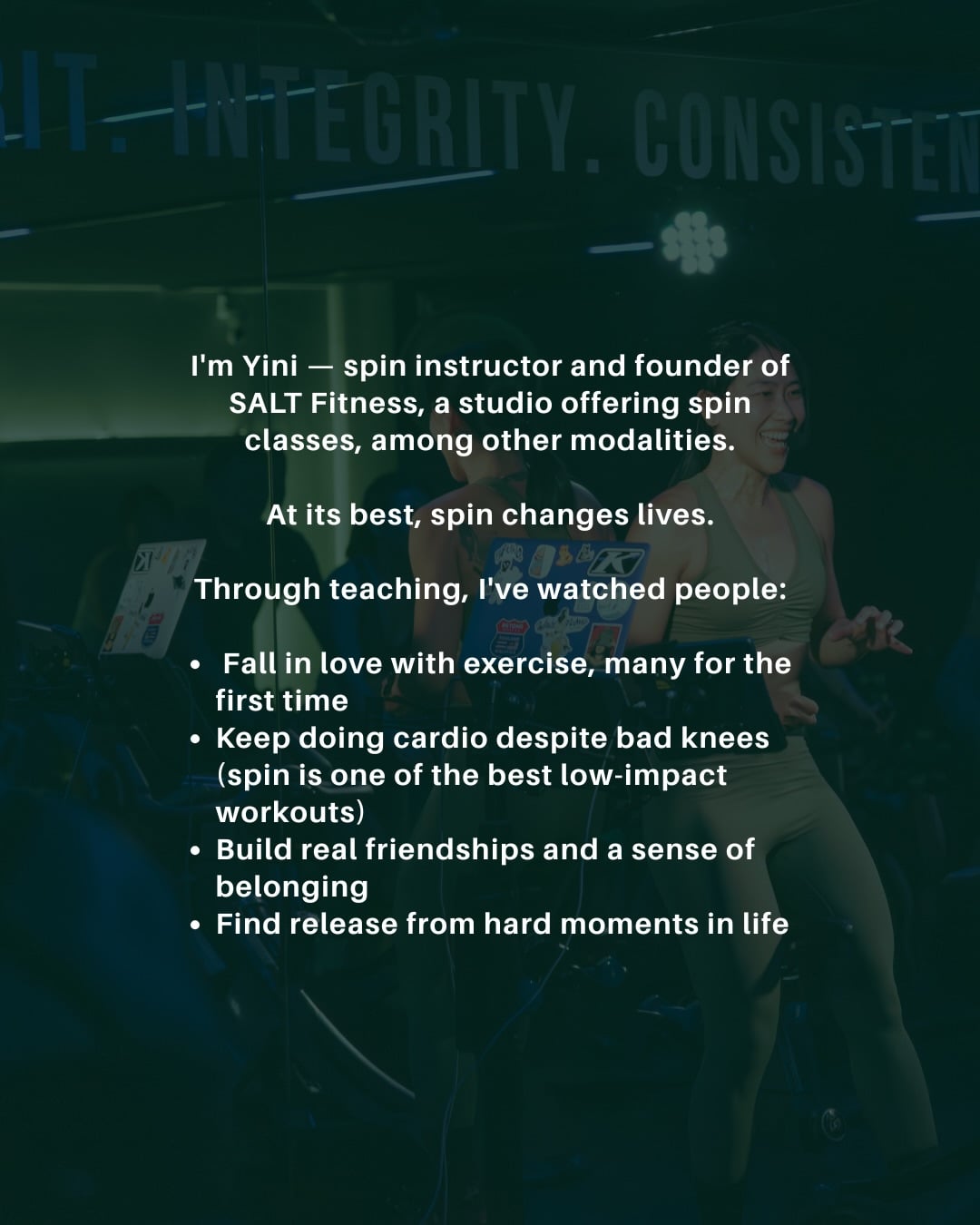
Source: @yyini on Instagram
Acknowledging that every sport carries risks, she argued that the key issue is how those risks are managed.
According to Yini, instructors today are trained to provide beginner-friendly options and monitor newcomers closely.
At SALT Fitness, she said, beginner modifications in every class are “non-negotiable”.
Addressing ST directly, she asked why the publication did not reach out to those within the industry.

Source: @yyini on Instagram
“Please don’t manufacture fear around a sport that has brought people so much good.”
She also encouraged fellow instructors and riders to share their own experiences to provide a broader perspective.
Online debate over whether spin was unfairly singled out
The article also prompted debate among readers on ST’s Facebook page.
Some commenters argued that rhabdomyolysis is not unique to spin, noting that it can occur after overexertion in virtually any form of exercise.
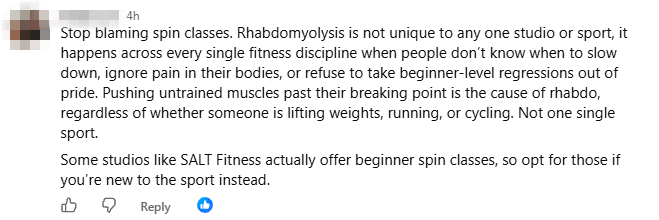
One Facebook user shared that they experienced similar symptoms of rhabdomyolysis after performing too many weighted squats as a beginner, before later returning safely to strength training.

One netizen suggested that beginners may push past their limits and end up missing signs that their body is “breaking down dangerously”.

Also read: Woman Nearly Gets Kidney Failure After Spin Class, Cautions Public To Hydrate After Intense Exercise
Woman Nearly Gets Kidney Failure After Spin Class, Cautions Public To Hydrate After Intense Exercise
Have news you must share? Get in touch with us via email at news@mustsharenews.com.
Featured image adapted from @yyini on Instagram and The Straits Times website.