
Through the lens of a divorce lawyer in Singapore: Navigating whether to stay or go
Divorce is rarely the result of a single bad day. More often, it reflects the accumulation of unresolved issues until a final straw is reached.
Couples often grapple with difficult questions: Can the relationship still be repaired? What does staying together mean for the children? Has resentment become the dominant language at home?
There is no universal answer.
Marriage deserves more than a reflexive exit after serious disagreement. However, staying should never mean accepting abuse, coercion or a home where one’s safety and dignity are compromised.
The more important question is not simply whether a marriage can endure, but whether it can be rebuilt into one that is healthy for everyone involved.
A good place to start the discourse is to understand why some couples make the conscious choice to stay.
Young children and the wish to preserve family life

Source: Christoph Theisinger on Unsplash. For illustration purposes only.
For parents of young children, keeping the family together is often a powerful motivation.
They want their children to benefit from the daily presence, love and guidance of both parents.
However, staying together solely for the children requires honest reflection. Children are highly sensitive to persistent conflict, emotional distance and unresolved hostility.
A home need not be perfect, but it should remain a safe and respectful space where children do not feel burdened by their parents’ relationship.
Where couples remain willing to communicate, seek help and address harmful patterns, preserving the marriage may be worthwhile.
Where conflict has become entrenched, divorce coupled with committed co-parenting may ultimately provide a healthier environment than prolonged conflict under one roof.
The long marriage: history, inertia and companionship

Source: Nguyen Thu Hoai. For illustration purposes only.
Older couples often approach divorce differently. A long marriage represents decades of shared experiences: raising children, caring for ageing parents, overcoming illness, building a home and navigating life’s challenges together.
After so many years, lives become deeply intertwined. Some conclude that everyday disagreements do not outweigh a lifetime of partnership and find renewed companionship later in life.
Others recognise that longevity alone should not justify remaining in an unhappy marriage. Time invested is important, but it should never silence a person’s legitimate need for peace, respect or safety.
A mature understanding of commitment
For many couples, marriage is a covenant rather than a contract. They understand that disagreements, changing habits and occasional frustrations do not necessarily signal failure.
Commitment often means choosing patience, learning to apologise, accepting differences and remembering the values that first brought two people together.
Not every conflict is a crisis. Lasting marriages often succeed because couples distinguish temporary frustrations from a deeper breakdown of trust, affection or mutual respect.

Source: Kelly Sikkema on Unsplash. For illustration purposes only.
At the other end of the spectrum, it is equally important to understand why others decide that ending the marriage is the better path forward.
While no two relationships are the same, there are common factors that lead some couples to conclude that it is time to “throw in the towel.”
When divorce becomes a recurring threat
Among younger couples, I sometimes see divorce raised too quickly during ordinary disagreements about finances, in-laws, work, intimacy or household responsibilities.
When divorce becomes a recurring threat, emotional security begins to erode. Every disagreement becomes a question of whether the marriage itself will survive.
Instead, couples should pause, identify the real issue, take time to cool down and seek professional support where necessary.
A marriage is strengthened not when one person wins every argument, but when both can express difficult concerns without fearing the relationship will be used as leverage.
Different opinions about child upbringing
Children often magnify differences that previously seemed manageable. Parents may disagree over discipline, education, screen time, spending, medical decisions or the role of grandparents.
These disagreements are rarely arbitrary. They often reflect each parent’s upbringing and deeply held beliefs about what is in the child’s best interests.
The objective is not identical parenting, but a workable middle ground with clear expectations, mutual respect and consistent boundaries where possible.
Following separation, this becomes even more important. Children should never be placed in the middle of adult disputes or expected to choose sides.
Unreasonable behaviour, betrayal and adultery
Some marriages are tested by repeated humiliation, controlling behaviour, dishonesty, violence or infidelity. These issues strike at the heart of trust and cannot simply be dismissed by encouraging greater patience or forgiveness.
The priority must always be the individual’s safety, emotional wellbeing and practical circumstances.
An affair may be a cause of divorce, but it can also reflect deeper problems within the relationship.
Every couple must honestly consider whether repair remains possible, or whether trust has been damaged beyond recovery.
Work, finances and invisible labour of home
Many marital disputes are not truly about money or household chores. Rather, they stem from whether each person feels appreciated.
One spouse may shoulder most of the financial responsibilities, while the other manages childcare, household administration and caring for elderly parents. Both contributions are valuable.
There is no single formula for a successful family. What matters is that the arrangement is openly agreed upon, financially sustainable and viewed as a shared responsibility rather than a competition.

Source: Engin Akyurt on Unsplash. For illustration purposes only.
Conversations about money, domestic labour and career sacrifices should occur before resentment hardens.
This is particularly important in a highly stressful society where rising financial pressures can further discourage couples from having children.
The implications are reflected in Singapore’s declining birth rates, with The Straits Times reporting that fewer than 30,000 babies were born in 2025.
This is the first time the figure has fallen below this threshold since the nation’s independence.
Empathy matters
As a practising family lawyer, I regularly meet people during some of the most difficult periods of their lives.
Behind every legal file is someone grieving the loss of a relationship, worrying about their children and trying to navigate a future they never imagined when they exchanged their vows.
Empathy matters. It does not require overlooking harmful conduct or compromising one’s legal position.
Rather, it means recognising that family disputes are not improved by unnecessary hostility, inflammatory exchanges or involving children in adult conflicts.
Sometimes, agreeing to disagree is not surrender but maturity.
Separated parents may never see eye to eye on every issue, but they can still establish arrangements that protect their children and allow both parents to remain meaningfully involved where it is safe and appropriate.
Singapore’s family justice system increasingly reflects this approach through therapeutic justice, emphasising problem-solving over adversarial conflict.
The courts have consistently encouraged parents to place their children’s welfare above personal grievances and have recognised the lasting harm caused when children become caught in parental disputes.
Reflections from practice

Source: Ronald Yeo
Therapeutic justice does not mean every marriage should be saved, nor that every divorce represents failure.
Sometimes the most responsible decision is to leave a relationship that has become unsafe or irretrievably broken down.
At other times, the wiser course is to slow down, seek help and give a worthwhile marriage a genuine opportunity to recover.
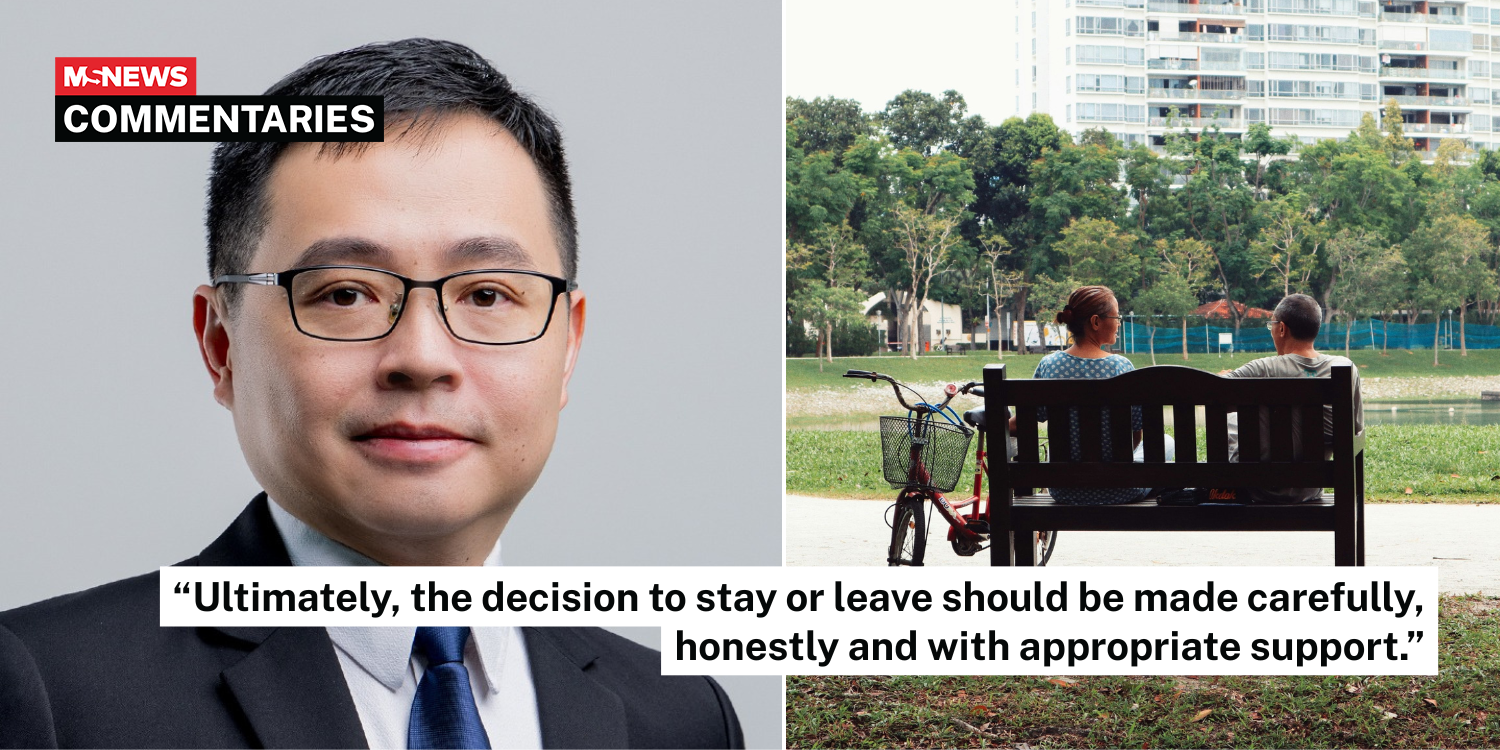
Ultimately, the decision to stay or leave should be made carefully, honestly and with appropriate support.
Where children are involved, the question should extend beyond “What do I want?” to “What will best protect their wellbeing now and in the years ahead?”
Whatever the answer, dignity, empathy and a commitment to minimising harm remain values worth carrying forward.
This article is intended for general information only. It is not legal advice. Individuals facing family violence, coercive control or an immediate safety concern should seek urgent assistance and appropriate professional support.
Ronald Yeo is a practising family lawyer.
Also read: Too embarrassed to ask? Why S’pore men still struggle to talk about sexual wellness
Too embarrassed to ask? Why S’pore men still struggle to talk about sexual wellness
Have news you must share? Get in touch with us via email at news@mustsharenews.com.
Featured image adapted from Ronald Yeo and Marek Studzinski on Unsplash. For illustration purposes only.