
MS Mysteries: Understanding the Mae Nak Shrine in Bangkok
Tucked within the grounds of Wat Mahabut temple in Bangkok’s Phra Khanong district is the sacred Mae Nak shrine.
It stood for decades as the go-to place for locals who seek blessings in love, good fortune, and even for those who wish to avoid conscription.
What gives the shrine its unusual reputation, however, is the enduring and tragic tale of its namesake ‘Mae Nak’, a female spirit in Thai folklore.
The ‘vengeful’ ghost of Phra Khanong
Similar to the Pontianak in Singapore, Mae Nak is the spirit of a woman who died during childbirth.
It is believed that she was a real person who lived in Bangkok’s Phra Khanong district during the 19th century.
Her real name was said to be Amdaeng Nak.
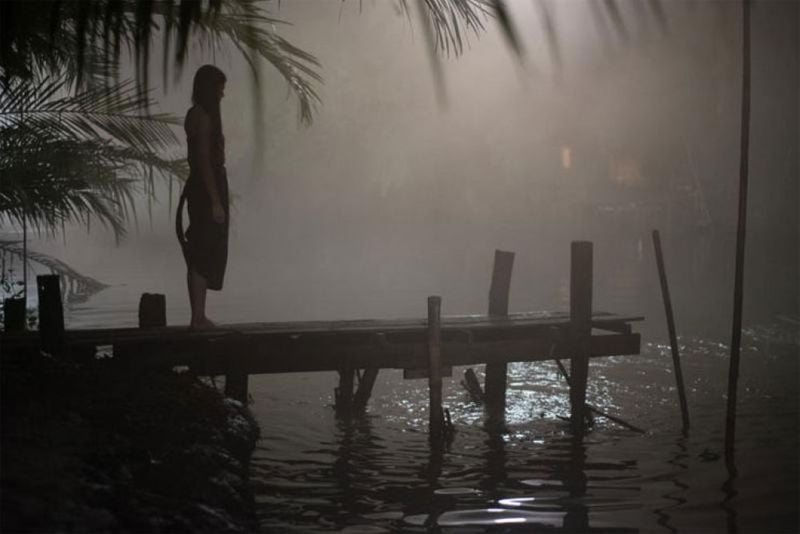
Source: blockdit, for illustration purposes only
Nak died during childbirth while her husband, Mak, was away at war.
As the story goes, Mak returned and lived with Nak and a newborn, unaware of her death.
Villagers later told him the truth that his wife was dead and that he was living with a ghost. However, he ignored the warnings.
One day, Mae Nak dropped a lime from the second-floor porch and stretched her arm to a supernatural length to pick it up from the ground.
Witnessing such an eerie sight, Mak fled to Wat Mahabut temple. Mae Nak tried to pursue him but failed to enter the sacred ground.
Angry with the villagers, she took revenge by haunting them for causing her husband to leave her.

Source: Sanook
To stop her from scaring people, a reverend monk confronted her, confined her in an earthen jar, and threw it into the Phra Khanong canal.
Years later, a fisherman found the jar and opened it, setting the vengeful spirit free again. She went back to terrorising people in the community.
Eventually, a monk approached her and convinced her to let go of her past and move on, saying she would be reunited with her husband in their next lives. She then voluntarily departed to be reborn.
Some details may vary, as the story has been retold in many different ways over time.
Tale allegedly fabricated by Mae Nak’s remaining children
While some wholeheartedly believe in the tale, there have been reports debunking the story — such as an article written by K.S.R. Kulap and published in The Siam Prabheth newspaper on 10 March 1899.
It alleged that the remaining older son of Mae Nak worried that his widowed father would remarry and share his wealth with his stepmother.
As a result, he invented the ghost story of his mother to scare people away.
Disguised in women’s clothes, the son haunted the village as his mother’s phantom, even paying men to hurl stones at passing boats near the cemetery.
Though the son eventually confessed, his admission did not end the trickery. Instead, it inspired a series of subsequent Mae Nak hauntings.
Shrine was created as tribute to her
The confession also did not stop locals from building a dedicated shrine in the Wat Mahabut temple complex, near where she lived in the 19th century.
Inside a pavilion, a gilded statue depicts Mae Nak seated with her infant child, Daeng, on her lap.
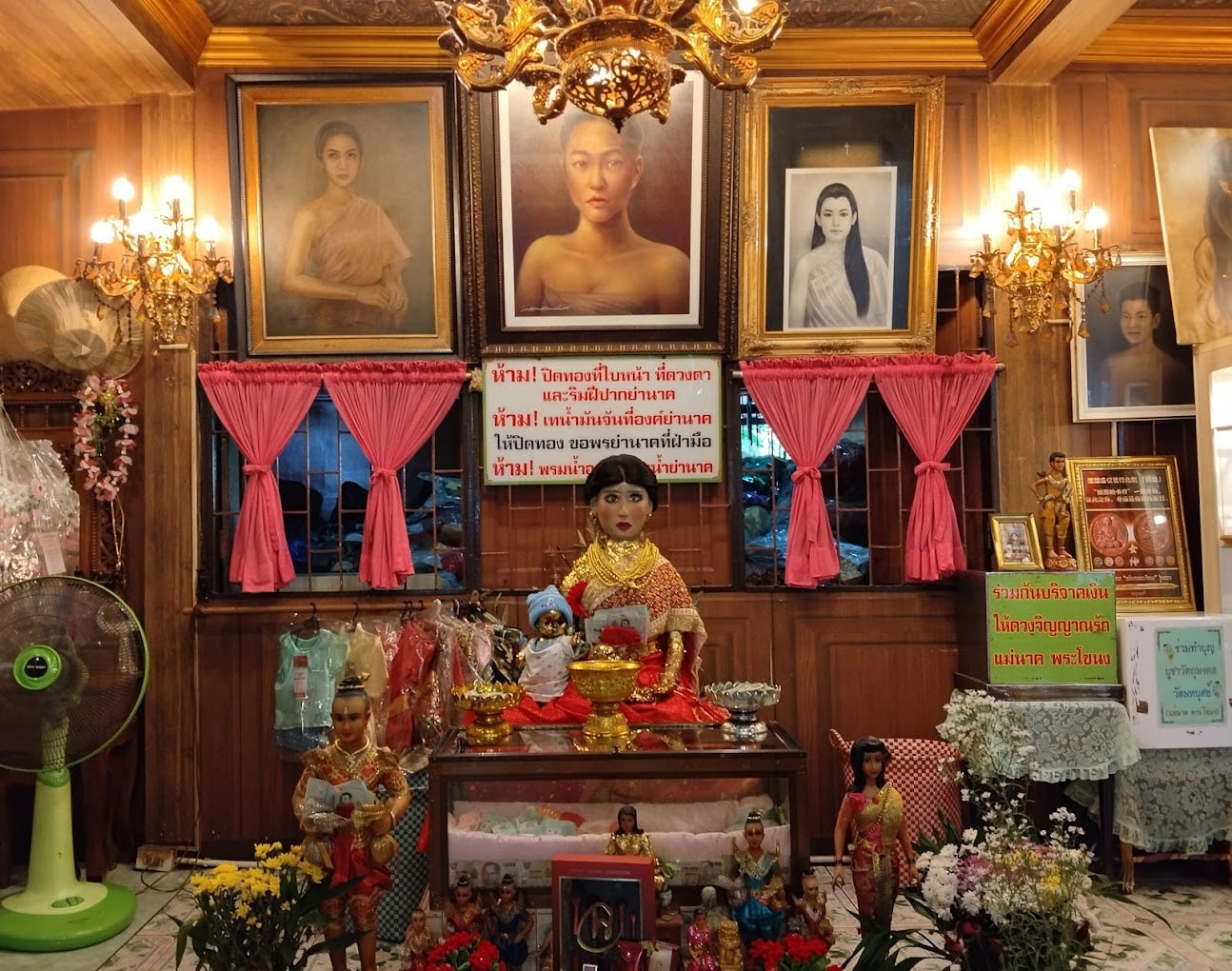
Source: Google Maps
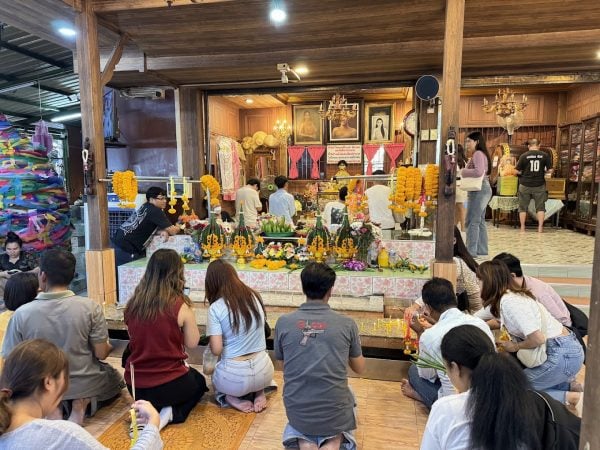
Visitors present traditional Thai dresses, fruits, flower garlands, and even children’s outfits as offerings to Mae Nak.
Due to her own separation from her husband, many Thais believe Mae Nak loathes anything that tears loved ones apart.
Consequently, many women visit her statue and pray for enduring and smooth relationships.
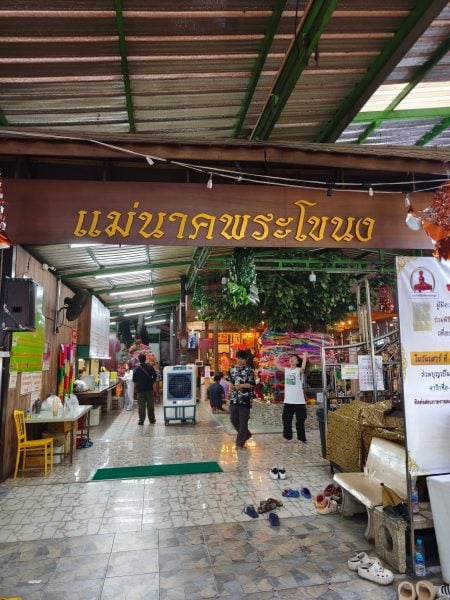
Source: เมืองไทยสมัยก่อน on Facebook
Married women struggling to conceive also come to ask for her blessings.
Meanwhile, expectant mothers pray for safe, painless births, trusting Mae Nak to shield them from the perils of labour.
Young men pray for luck in escaping the military draft
For young Thai men hoping to escape the military draft, the Mae Nak Shrine is the ultimate go-to sanctuary.
Every April, Thai men aged 21 undergo the annual military conscription lottery. Drawing a red card means two years of mandatory military service, while drawing a black card grants exemption.
Because Mae Nak’s tragedy was triggered by her husband Mak being conscripted and taken away to war, her spirit is believed to deeply hate the separation of families caused by military service.
Source: Google Maps
Thousands of young men and their mothers visit the shrine on the nights leading up to the draft to pray specifically for a black card.
Several men shared that their wishes had come true and they were exempted from the draft.
Additionally, people seek her blessings for winning lottery numbers.
Local sightings of Mae Nak
Mae Nak’s formidable powers are spoken of by many, particularly residents around Wat Mahabut, her reputed final resting place.
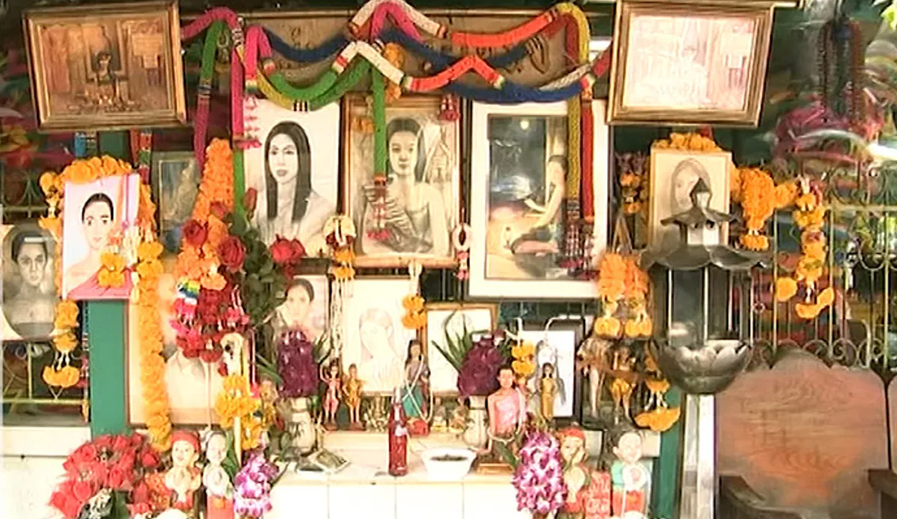
People walking past the temple grounds at dusk regularly report sightings of Mae Nak playing with her young child in the area.
At times, her child would cling to a tree branch by his feet, dangling upside down while sticking out his tongue and making faces to frighten passersby.
Source: Sanook
Those walking past Mae Nak’s home, which had fallen into ruin and sat abandoned, would hear the sound of someone pounding chilli paste with a mortar and pestle, even before sunset.
Looking over, they would see Mae Nak herself pounding the spices.
When the pestle slipped from her hand and fell through the floorboards to the space beneath the raised house, Mae Nak would stretch her arm to extraordinary lengths down below to retrieve it.
Popularity of the figure in Thai culture
M.R. Kukrit Pramoj, Thailand’s 13th Prime Minister, once shared a childhood memory of Mae Nak, recalling that when he was about ten years old, adults took him to Wat Mahabut.
Upon stepping onto the new wooden sermon hall, he saw multiple muddy footprints stamped across the newly whitewashed ceiling.
The abbot pointed them out to the group, explaining that they were the footprints of Mae Nak, who had walked across the ceiling upside down.
The story of Mae Nak of Phra Khanong has also seen multiple screen adaptations such as the successful 2013 horror-comedy film Pee Mak.
Until today, Mae Nak’s legacy continues to endure in popular imagination and the shrine still stands as a tribute to her story.
Have news you must share? Get in touch with us via email at news@mustsharenews.com.
Featured image by Thailand Foundation and Blockdit, for illustration purposes only.