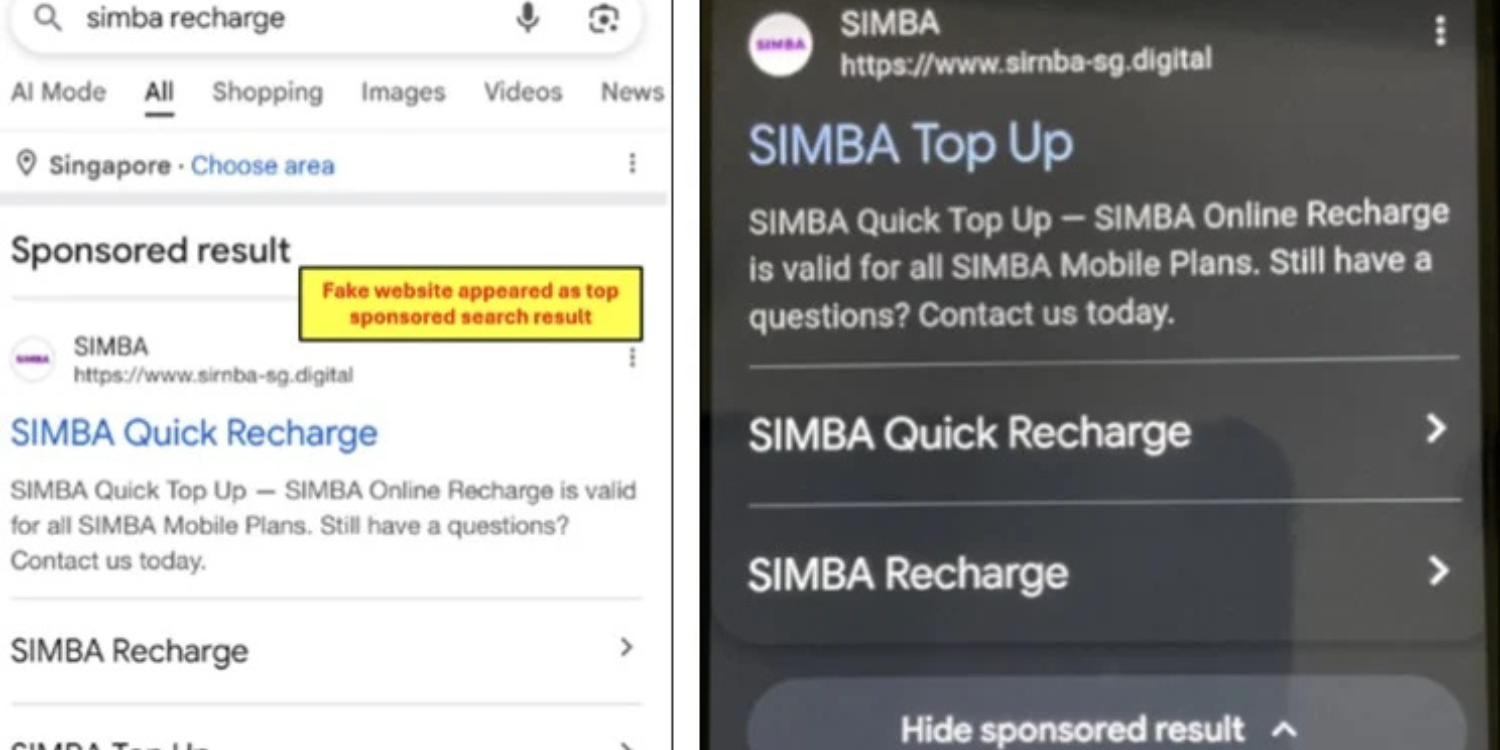

At least S$83,000 lost to fake phishing websites impersonating SIMBA appears in Google’s top results
On 21 Oct, the Singapore Police Force (SPF) warned about a rise in phishing scams impersonating the telecommunications company SIMBA.
The phishing websites appear in Google search results, and since Mar of this year, the police have received at least 62 reports.
Through the investigation, the police estimated total losses at at least S$83,000.
Fake websites appearing in top Google search results
According to the police, victims would use Google to search for SIMBA top-up services.
They would find and click on fake SIMBA websites that appeared among the top sponsored results.
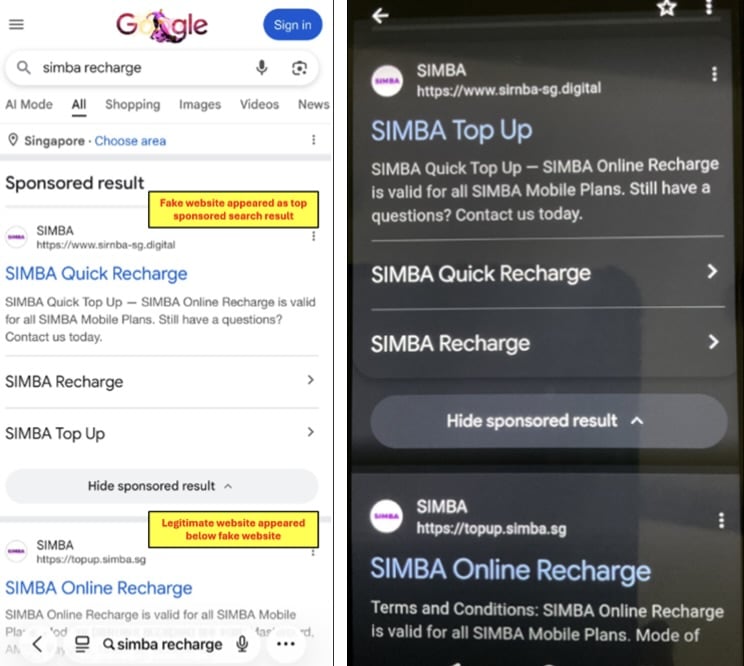
Source: Singapore Police Force
The websites then prompted victims to enter personal and banking details, such as mobile numbers and bank card information.
Additionally, victims had to provide digital token approvals or OTPs on the phishing websites.
Only after the process did victims realise they had been scammed when they discovered unauthorised card transactions.
Source: Singapore Police Force
Do not immediately click on websites, even if they are the top results
As such, the police remind the public to be wary of websites that appear at the top of search engine results.
Even if they have popular brand names, these websites or sponsored advertisements can still be phishing sites.
Source: cottonbro studio on Pexels, for illustration purposes only
To stay safe, check the website address carefully, use a previously saved bookmark or type the known address directly instead of using search engines.
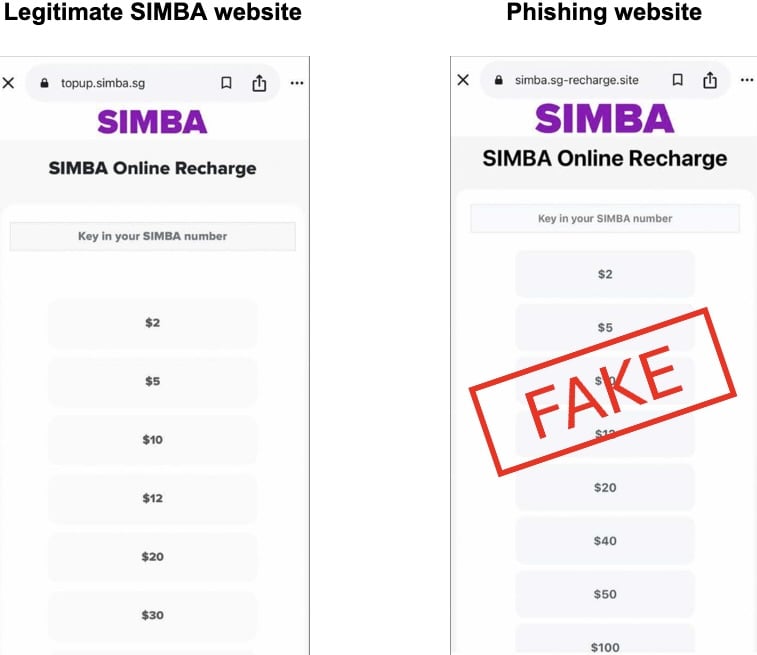
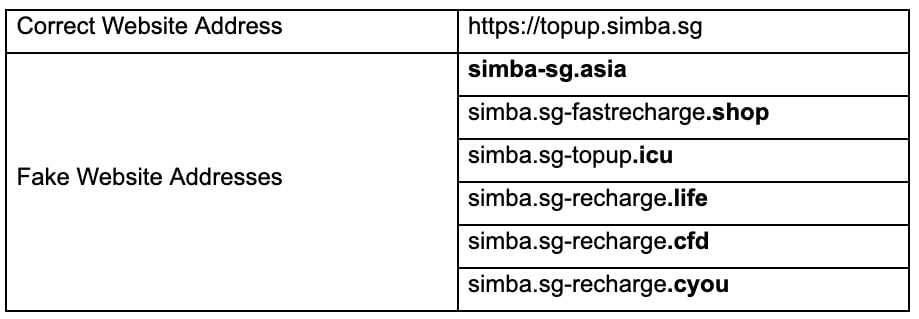
Additionally, members of the public should note that phishing websites use domain extensions different from SIMBA’s legitimate domain.
Here are some of the examples of fake websites that impersonated SIMBA’s website:
Source: Singapore Police Force
Police advise adopting A.C.T as a precautionary measure
Thus, the police advise the public to adopt the following precautionary measures.
First, you can add security features such as Two-Factor (2FA)/Multifactor authentication for banks and online accounts.
Also, set transaction limits for internet banking and install a Money Lock to protect part of your savings from scams.
Remember that you should not disclose your personal information, bank/card details, and One-Time Passwords (OTPs) to anyone.
Second, always check the webpage address carefully for any discrepancies such as misspellings, extra words, or incorrect domains, and verify the authenticity of any links before clicking on them.
Lastly, tell the authorities, your family, and friends about scams.
If you suspect that you have fallen victim to a scam, contact your bank immediately to report and block any fraudulent transactions, and lodge a police report.
For more information on scams, members of the public can visit scamshield.gov.sg.
Also read: 2 M’sian men arrested over impersonation scams involving YouTrip, MAS & police, victims lose S$55K
2 M’sian men arrested over impersonation scams involving YouTrip, MAS & police, victims lose S$55K
Have news you must share? Get in touch with us via email at news@mustsharenews.com.
Featured image adapted from Singapore Police Force and Google Maps.