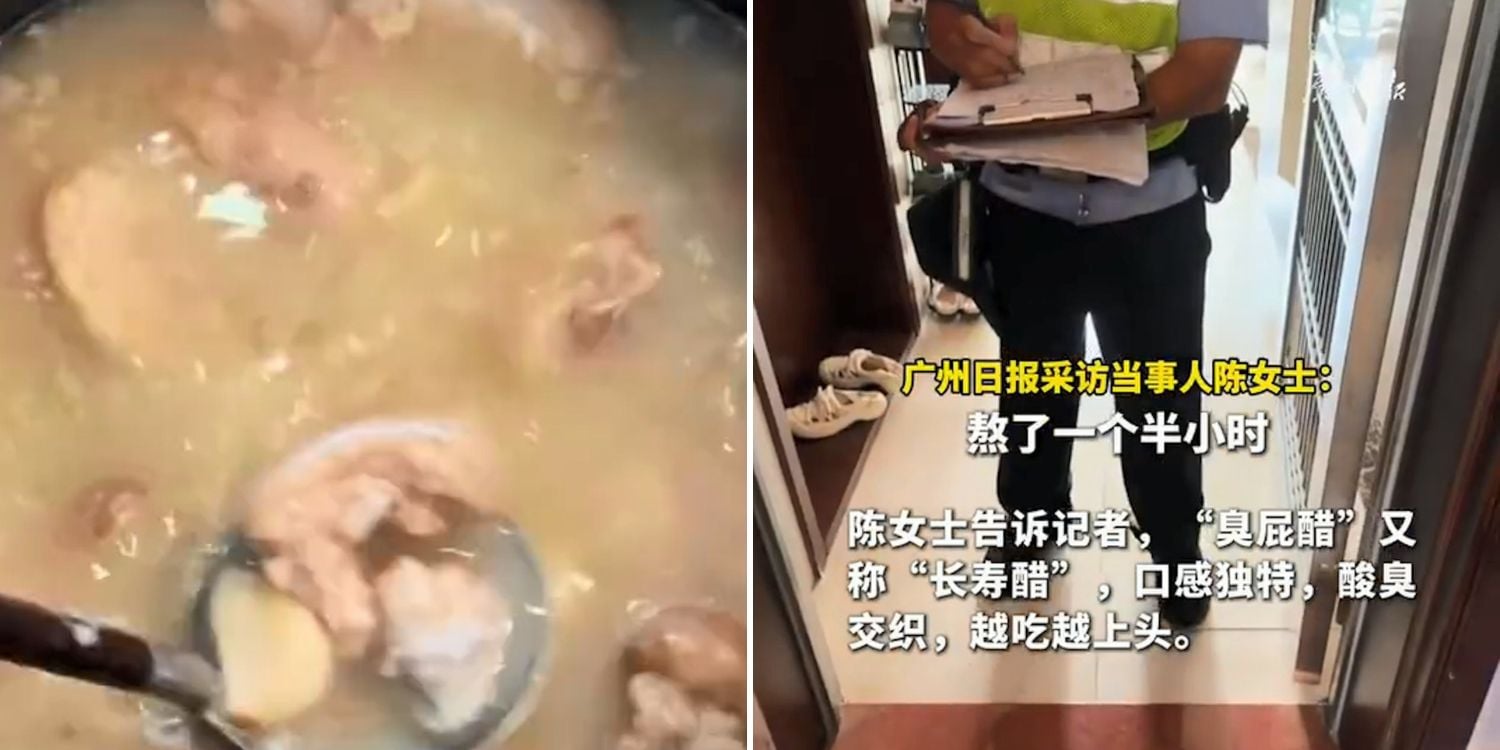

Tenant calls police after mistaking stinky fart vinegar for rotting corpse
A routine cooking session led to a police investigation when a tenant in a residential block in Guangdong, China, mistook the pungent aroma of traditional stinky vinegar for a corpse.
Corpse stench turns out to be neighbour’s stinky vinegar
On 14 July, a woman named Chen posted online that her neighbour had called the police, thinking someone had died in the building.
Upon receiving the report, the police arrived to investigate Ms Chen’s home.
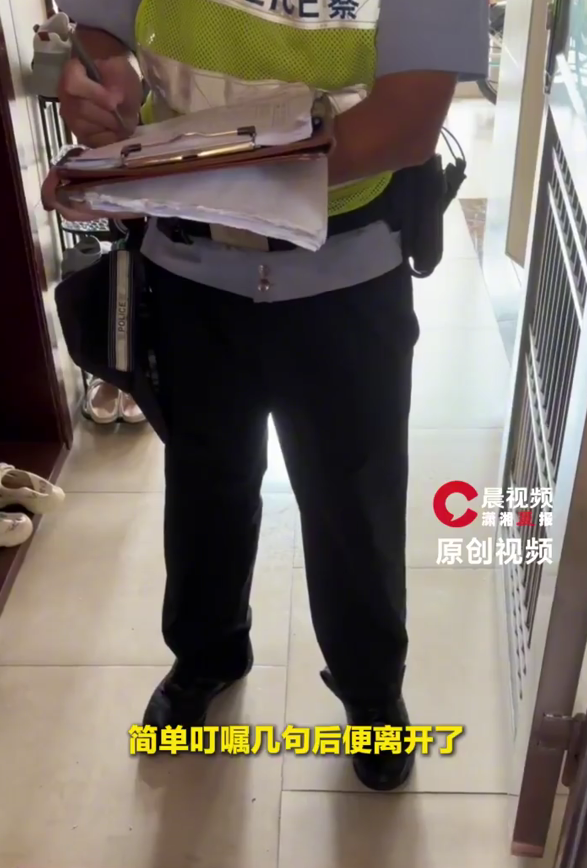
Source: Xiaoxiang Morning Post on Weibo
However, they discovered that the smell resembling a rotting corpse was “stinky fart vinegar”, an intensely fermented ingredient.
Ms Chen had been preparing a soup that included the pungent condiment, the South China Morning Post (SCMP) reported.
“My neighbour thought I was cooking a dead body,” she wrote, tagging the post “the power of stinky vinegar.”
Ingredient used in Guangdong for more than 2,000 years
Known locally as “stinky fart vinegar” or longevity vinegar, the ingredient has been used in Guangdong for over 2,000 years.
Many gourmets also dub it “liquid durian” due to its off-putting smell but delicious flavour.
Legend has it that, during the late Yuan Dynasty, a filial man preserved fried rice in a jar to feed his sick mother.
Because the family lived in a dilapidated house with a leaky roof, rainwater filled the jar, causing the rice inside to ferment and have a foul odour.
One day, when he had no food left to offer, he cooked the rice and served it to his mother, who miraculously got better a few days later.
Word quickly spread about the “stinky water’s” healing properties, prompting the man to open a “stinky vinegar” shop and pass down the recipe to locals.
Stinky fart vinegar listed as intangible cultural heritage
Today, stinky vinegar is listed as intangible cultural heritage in several areas in Guangdong, including Huadu District and Fogang County.
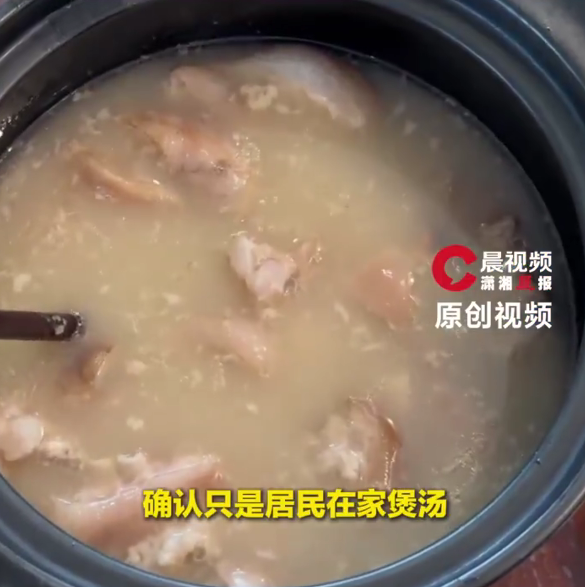
Source: Xiaoxiang Morning Post on Weibo
Huang Weihua, an officially recognised inheritor of the ingredient in Huadu, shared that he uses specially sourced broken rice as the core ingredient.
He stir-fries this for over 40 minutes until golden, then ferments it in a jar with spring or well water for three months.
Used to nourish women during post-partum confinement
The vinegar is traditionally cooked with pig’s feet, ginger, and eggs during post-partum confinement to nourish women, SCMP reported.
Elderly women in families would prepare it three months before the expectant mother’s due date so that it would be ready in time for the baby’s arrival.
Families with newborns would also share the home-made vinegar with neighbours to wish for a “good grandchild,” as the Cantonese word for “sour” sounds similar to “grandchild.”
It is also believed to stimulate appetite, improve digestion, alleviate blood stasis, and reduce summer fatigue.
Netizens respond to story with humour
Many social media users responded to the Ms Chen’s story with humour.
“This is the first time I’ve heard that cooking soup can be mistaken for a crime. The neighbour is a genius,” one user commented, according to SCMP.
Meanwhile, another netizen shared: “The longevity vinegar really stinks. My son once had chicken feet cooked in it, and his fingers smelled terrible afterwards.”
Also read: ‘Lion’ spotted roaming Ireland forest turns out to be dog with new haircut
‘Lion’ spotted roaming Ireland forest turns out to be dog with new haircut
Have news you must share? Get in touch with us via email at news@mustsharenews.com.
Featured image adapted from Xiaoxiang Morning Post on Weibo.