

MS Explains: The unusual skin reaction that can appear after taking medication
Imagine taking a new medication and, a few hours or days later, noticing a sharply defined red rash across your buttocks, groin, or inner thighs.
It might look alarming, but if you otherwise feel fine, it could be a rare drug reaction known as “baboon syndrome”.
The medical term more commonly used today is symmetrical drug-related intertriginous and flexural exanthema, or SDRIFE.
The term “baboon syndrome” derived from the distinctive appearance of the rash on the buttocks, which was said to resemble a baboon’s red rump.
So, what causes it, and can it be treated?
What is baboon syndrome?
SDRIFE is a type of delayed hypersensitivity reaction that occurs after exposure to a drug taken or administered systemically, such as orally or intravenously.
The rash typically develops within hours to several days after exposure, although the timing can vary.
Characteristically, it affects the buttocks, groin, and other skin folds in a symmetrical pattern.

Source: DermNet
It usually causes:
- Well-defined redness around the buttocks or perianal area
- A V-shaped rash around the groin or upper inner thighs
- Redness in other skin folds, such as the armpits
- A symmetrical pattern affecting both sides of the body
A feature that helps distinguish SDRIFE from some more serious drug reactions is the absence of systemic symptoms such as fever or significant illness.
One patient’s experience
For 31-year-old Denson Chow, who works in marketing, his experience with SDRIFE was subtle and potentially easy to overlook.
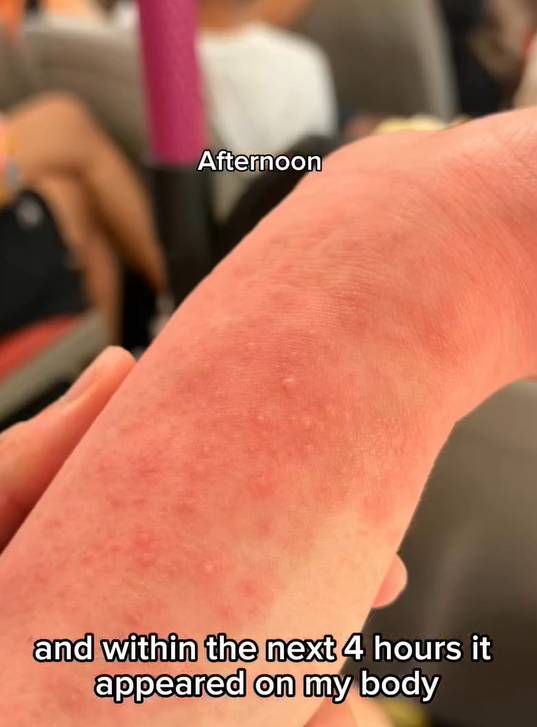
He first noticed the rash on his wrists on 26 Sept, initially dismissing it as an ordinary rash.
In an exclusive with MS News, Mr Chow said: “Looked like a normal rash, felt like mosquito bites.”
Source: @densonccc on Instagram
He visited a doctor that morning and was told that the reaction was likely caused by something he had touched. However, the rash continued to worsen throughout the day.
Mr Chow sought a second medical opinion that afternoon and was given a similar assessment.
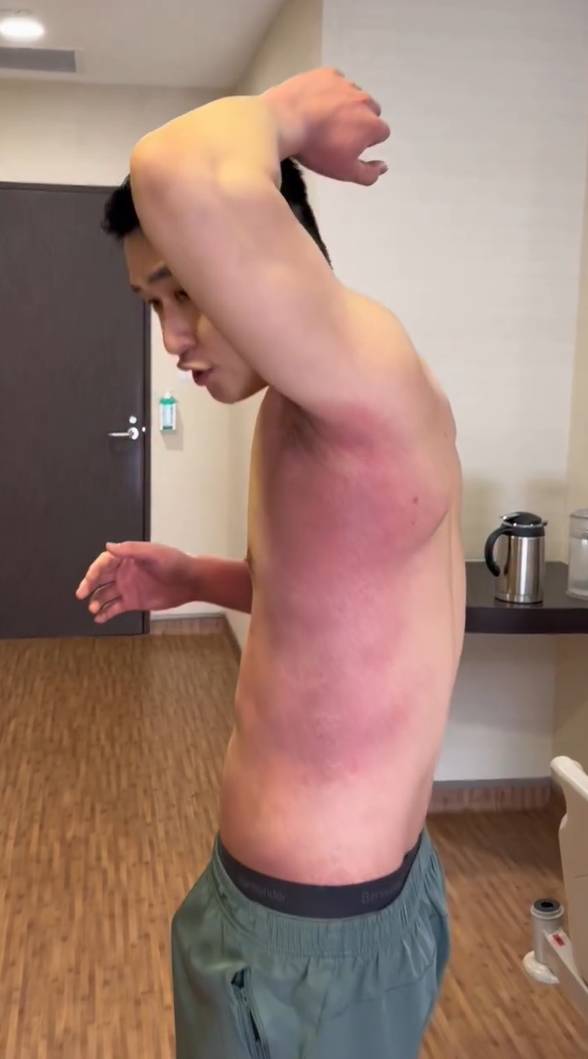
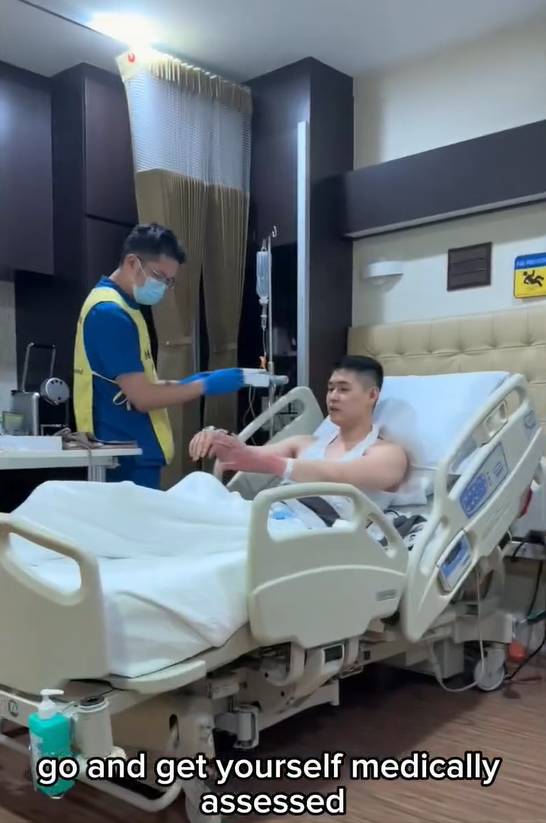
“By evening, it was a lot worse, so I got admitted,” he recounted.
Source: @densonccc on Instagram
He was subsequently diagnosed with a drug allergy, with antibiotics identified as the likely culprit.
His treatment included corticosteroid injections, as well as oral corticosteroids, and he recovered in about 10 days.
What causes it?
Several medications have been associated with SDRIFE.
Beta-lactam antibiotics, including penicillins and cephalosporins, are among the most common triggers, with amoxicillin particularly well documented.
Other medications, including some chemotherapy drugs and other classes of medicines, have also been reported.
Importantly, SDRIFE can occur after a person’s first dose of a medication, as well as after repeated exposure.
The reaction is thought to involve a type IV delayed hypersensitivity response.
How is baboon syndrome diagnosed?
Doctors usually diagnose SDRIFE based on the appearance and distribution of the rash, together with the patient’s medication history.
Commonly used diagnostic criteria include:
- Exposure to a systemic medication
- A sharply defined rash around the buttocks or perianal area, and/or a V-shaped rash around the groin
- Involvement of at least one other skin fold
- A symmetrical distribution
- Absence of systemic symptoms or signs of systemic toxicity
Source: @densonccc on Instagram
In some cases, doctors may perform a skin biopsy or allergy testing to help distinguish SDRIFE from other skin conditions and drug reactions.
However, the diagnosis is primarily clinical, based on the characteristic rash and its relationship to drug exposure.
Mr Chow’s case also demonstrates why seeking medical attention can be important when a rash is rapidly worsening or changing, particularly when there has been recent medication exposure.
His initial rash on the wrists did not immediately resemble the classic description of SDRIFE.
Is baboon syndrome treatable?
The answer is yes. SDRIFE is generally self-limiting and has a good prognosis.
When a particular medication is identified as the likely trigger, doctors may recommend stopping it and, where necessary, replacing it with an appropriate alternative.
Treatment is generally aimed at controlling the inflammation and symptoms. Topical or systemic corticosteroids may be used, depending on the severity of the reaction.
However, treatment should be determined by a doctor based on the individual patient’s symptoms and the suspected medication.
A drug that causes a reaction should not simply be stopped or restarted without appropriate medical advice.
When should you see a doctor?
A new rash after taking medication should not automatically be assumed to be SDRIFE.
Some drug reactions can be much more serious, particularly if the rash is accompanied by fever, facial swelling, difficulty breathing, blistering, skin peeling, mouth or eye sores, or significant illness.
Anyone experiencing these symptoms should seek urgent medical attention rather than assuming it is baboon syndrome.

Source: Rido on Canva for illustration purposes only
For people who develop a new or worsening rash after taking medication, a doctor can assess whether SDRIFE or another drug reaction is the likely cause and determine the appropriate treatment.
While “baboon syndrome” may sound unusual, the condition is generally benign and treatable.
The key is recognising the rash, taking note of any recent medication exposure and seeking medical assessment when symptoms are persistent or worsening.
Also read: Why was PCOS renamed & what does this mean for women with the condition?
Why was PCOS renamed & what does this mean for women with the condition?
Have news you must share? Get in touch with us via email at news@mustsharenews.com.
Featured image adapted from @densonccc on Instagram.