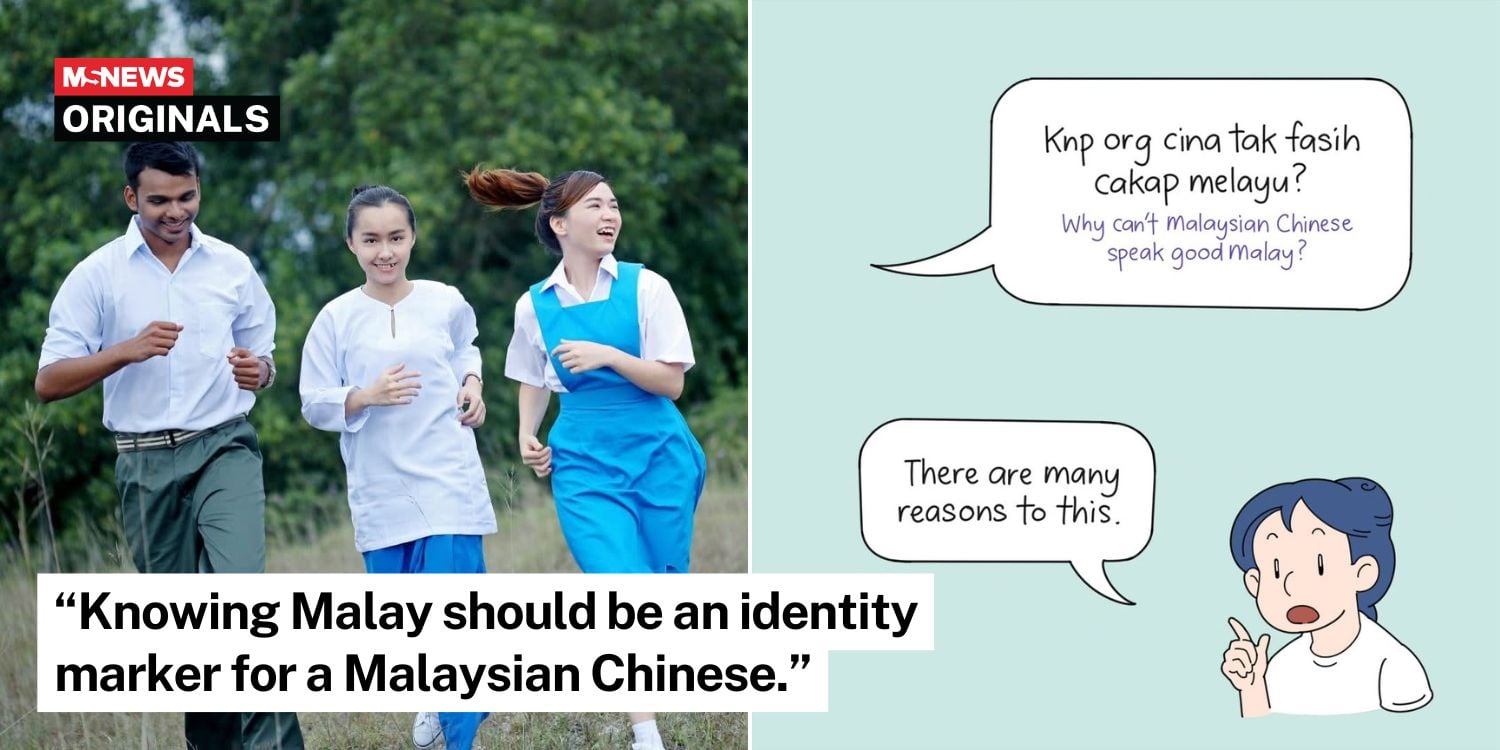

Cartoonist shares challenges in learning Malay as Chinese Malaysian
In multicultural societies such as Malaysia and Singapore, it is not uncommon to be multilingual. However, it is fair to say that proficiency levels in these languages may vary.
On Friday (12 June), illustrator Rachel Wan shared a series of cartoons she drew in an attempt to answer: “Why can’t Malaysian Chinese speak good Malay?”
The post is a part of a series covering Malaysian culture, with many of them focused around language.
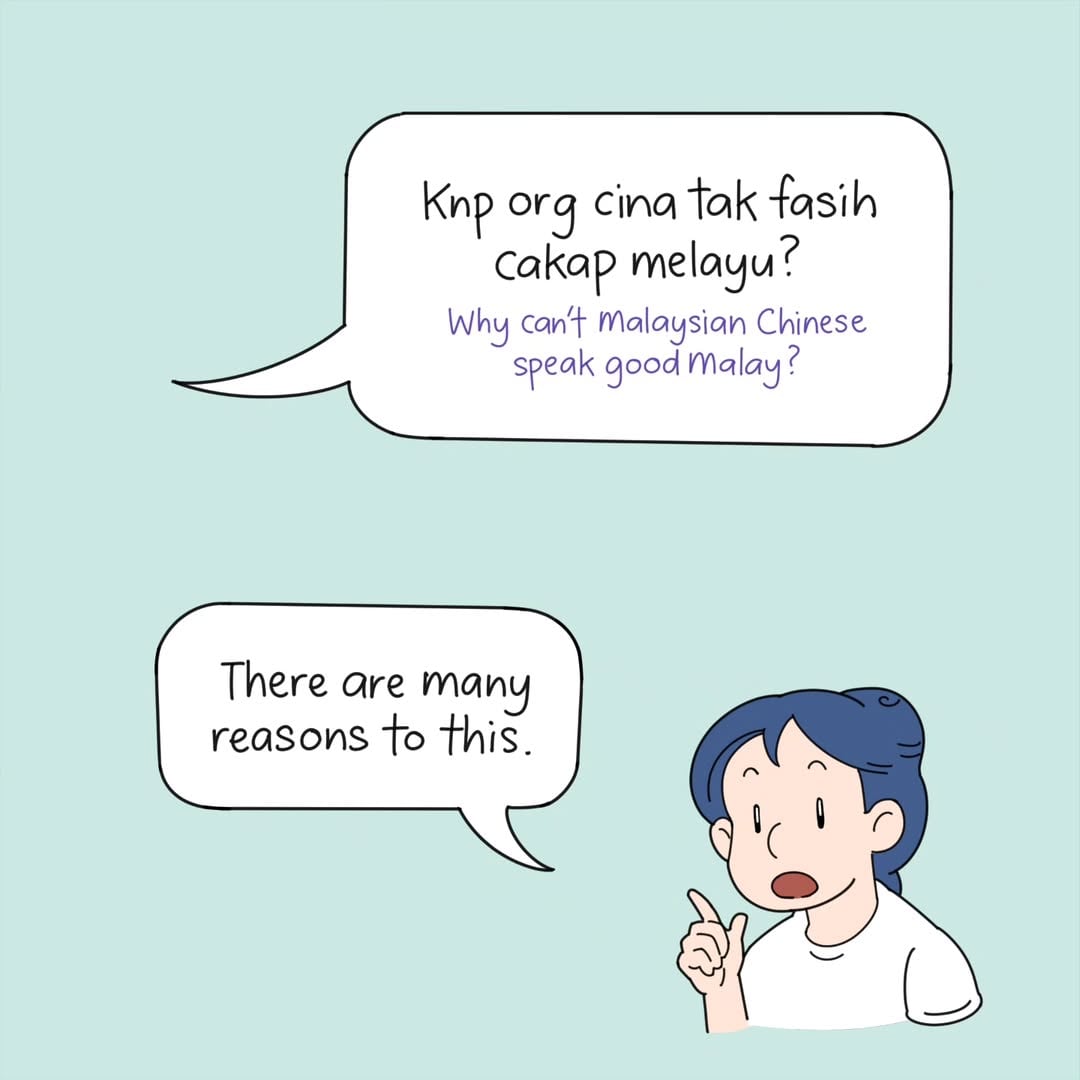
Source: @rachelwan.art on Instagram
She shared the drawings on Reddit and other social media platforms, which instantly got discussions going from Malaysians and Singaporeans alike.
Language as a product of upbringing
In her post, Rachel shared multiple factors that contribute to why Malaysian Chinese often struggle with speaking Malay.
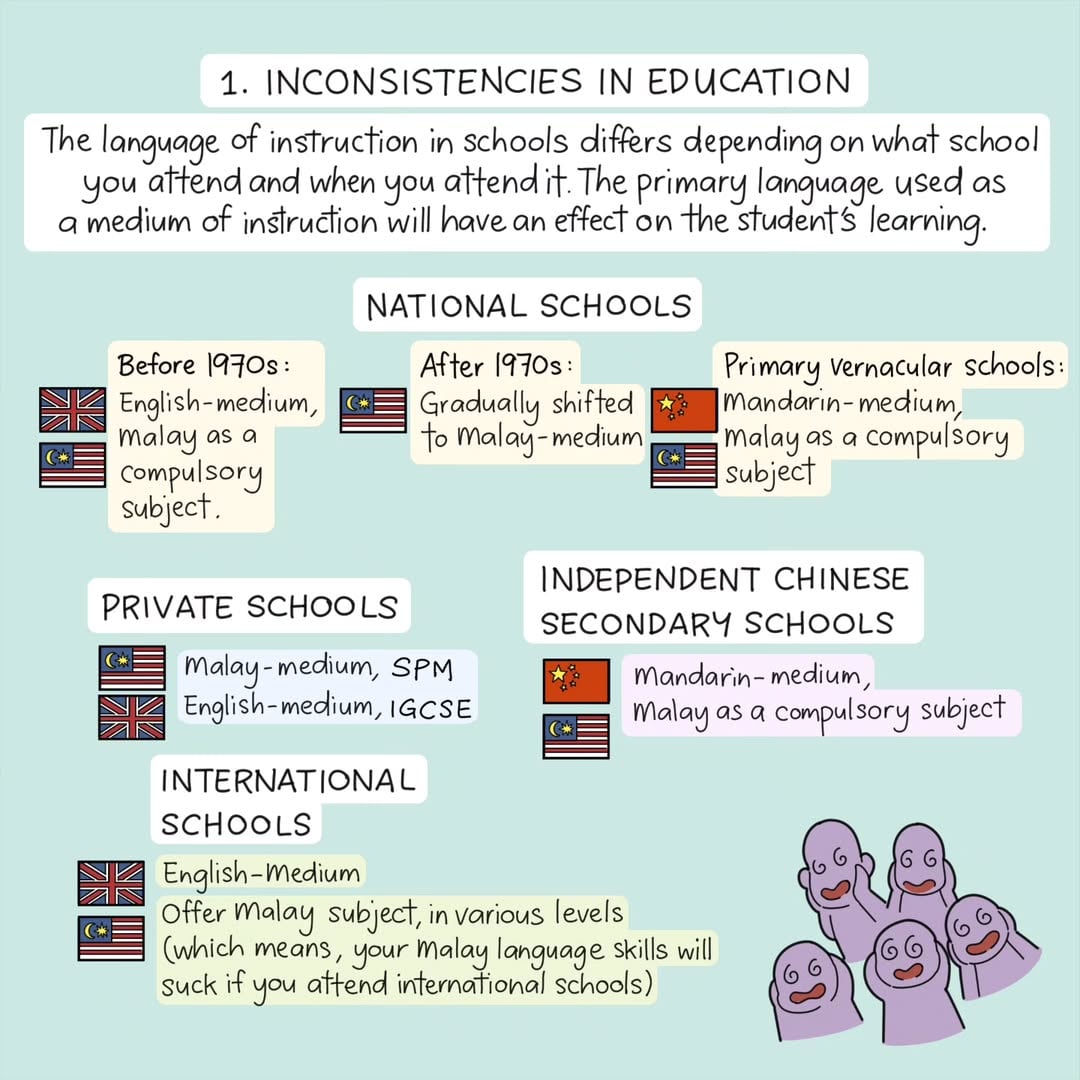
First is that the language is often taught differently depending on where you went to school.
Source: @rachelwan.art on Instagram
Next, even if you did learn it in school, did you use it consistently? If the answer is no, then chances are that you will not be as fluent.
“Unless you grew up in Malay-majority areas, your chances of using the language are slim,” Rachel wrote.
She even added that most will only use Malay to order food from vendors.
For the illustrator, this point hits close to home as she grew up in a neighbourhood where most spoke English.
“I was never placed in a situation where I needed to use Malay heavily,” she told MS News.
Even her Malay friends spoke English to her, she added.
Rachel only began to notice the differences between academic and spoken Malay while conversing with her Indonesian domestic helper.
“That’s when I noticed what we learnt in school is vastly different from how it’s spoken daily,” she said.
Malay in school is not always the same Malay used socially
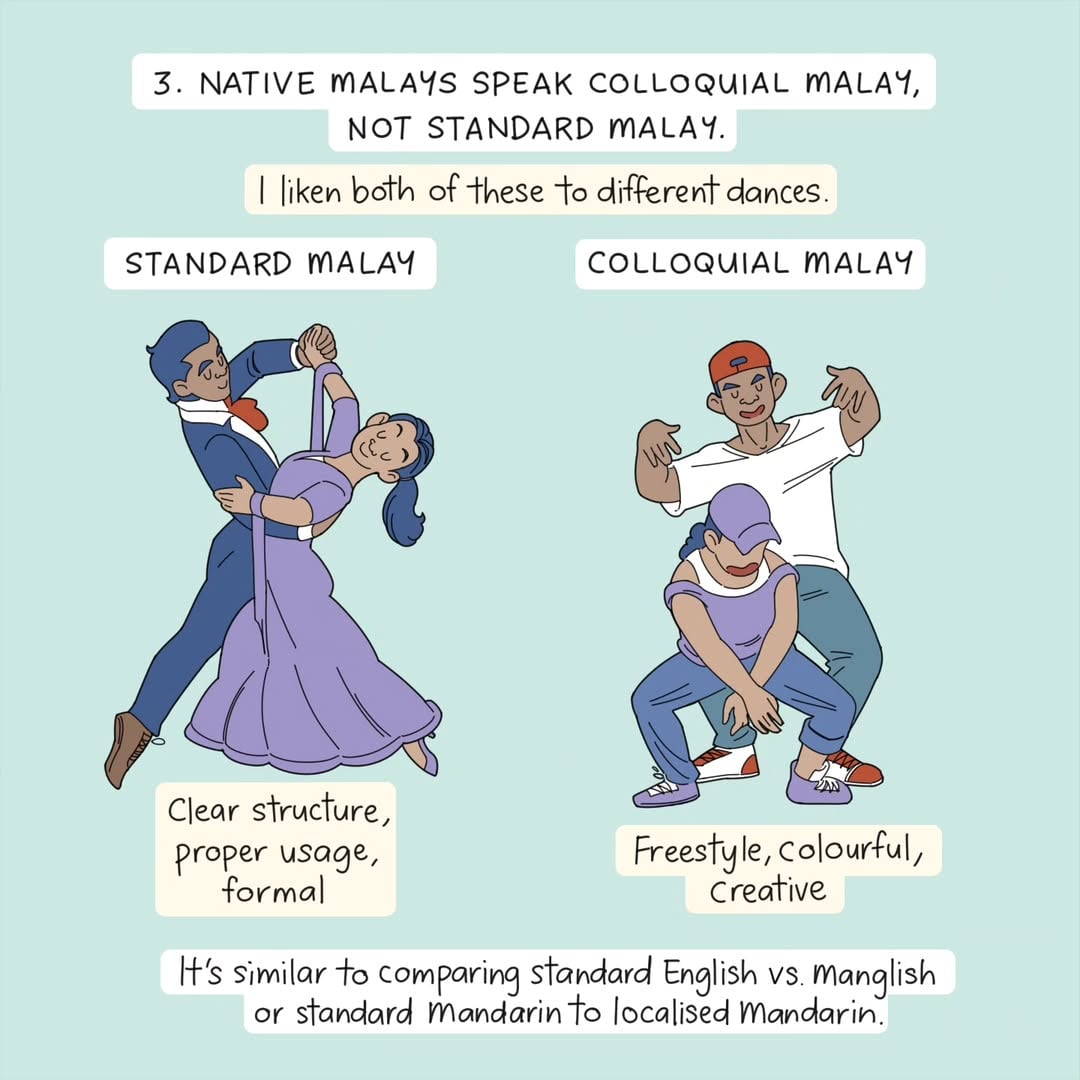
In her third point, Rachel describes Standard Malay as being structured and formal while colloquial Malay as more freestyle and creative.
Source: @rachelwan.art on Instagram
“Words are simplified,” she wrote. “It’s meant to be fast and efficient.”
This even extends to texting where sometimes vowels are removed and numbers replace words.
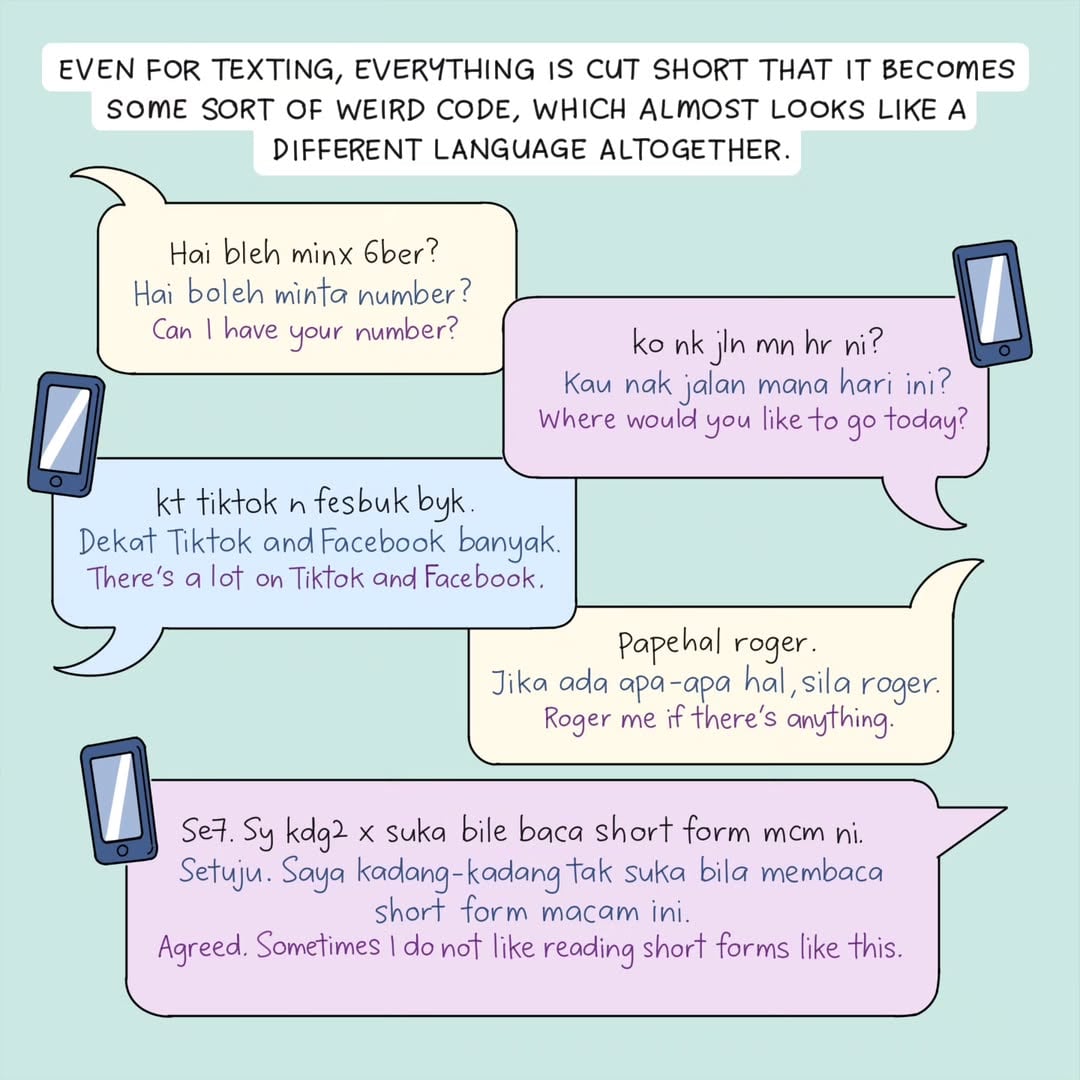
Source: @rachelwan.art on Instagram
To truly be fluent, Rachel says you would need “a bit of stalking, overhearing, active listening, and deciphering.
This is because the Malay used by fluent speakers can also change depending on who they are speaking to.
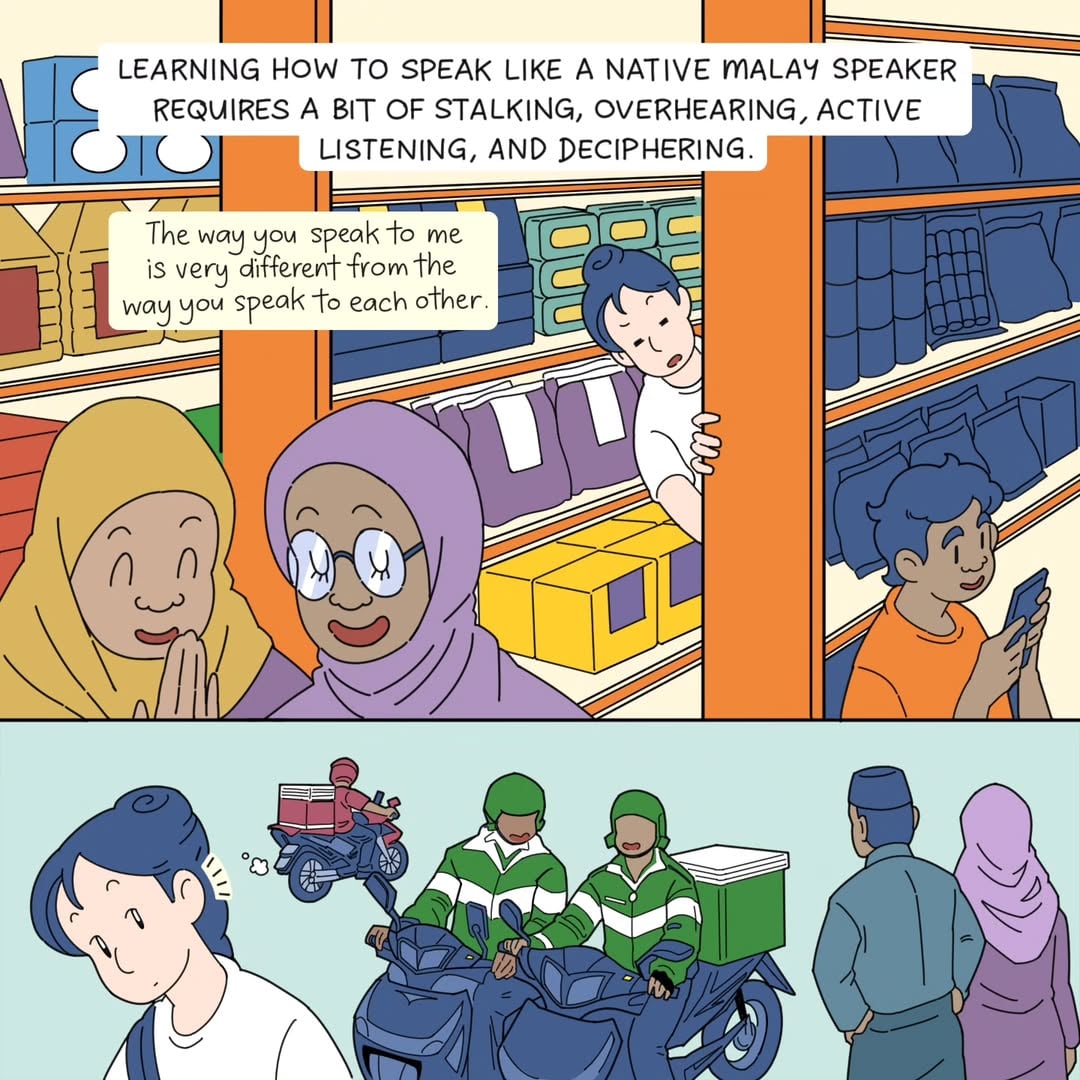
Source: @rachelwan.art on Instagram
“The way you speak to me is very different from the way you speak to each other,” she clarified.
Rachel shared one particularly difficult example for her to MS News — pronouns.
When addressing oneself in Malay, you have the choice between ‘saya’ and ‘aku’. One is more formal and the other is often used when with friends.
“Later I learnt that it’s better for a non-Malay to use “saya” unless another native Malay speaker considers you to be a part of their friend group,” Rachel explained.
While learning the language has been daunting, Rachel finds joy in the process.
“It’s all very, very confusing. Until today I’m wondering whether I’m using words correctly,” she said.
“But it’s a lot of fun.”
The importance of learning Malay as a Chinese Malaysian
In her Reddit post, Rachel wrote a caption that generated much discussion.
“As long as we can speak better Malay than a Singaporean, all is well,” she quipped.
The comment amused some netizens, with one wondering if Singaporeans actually understand from the national anthem.

Source: Reddit
Another pondered why Malay continued to be one of Singapore’s official languages.

Source: Reddit
Rachel explained to MS News that the caption was meant to differentiate Chinese Malaysians and Chinese Singaporeans.
“Learning Malay and knowing the language should be an identity marker for a Malaysian Chinese, even if you can’t speak it well,” she said.
However, she also remarked that Singapore may be more cohesive because of the English language.
Rachel elaborated that having English as the medium of instruction ensured that “no one has an upper hand”.
“It was also highly practical, easier to communicate with the outside world,” she wrote.
Language required to experience the depth of Malaysian culture
For Rachel, one cannot experience Malaysia fully without understanding its languages.
“Let’s just say, in order to experience the whole of Malaysia, you should know as many languages the land has to offer,” she said.
For a Malaysian Chinese, the criteria should be a minimum of three.
Since 2024, Rachel has been posting comics in an attempt to explain her experience as a Chinese Malaysian.
Her comics frequently draw hundreds of comments on Reddit.
Despite being a millennial with multiple decades of experience with Malaysia, Rachel says she still finds her perspective of the country to be “rather narrow”.
“To be honest, until today I find it very difficult to explain my country to the world,” she said.
“I would just like draw more about my experience living in Malaysia and hopefully, show a glimpse of my reality to the world.”
Have news you must share? Get in touch with us via email at news@mustsharenews.com.
Featured image adapted from ASEAN World 24 – Southeast Asia Network on Facebook and @rachelwan.art on Instagram.