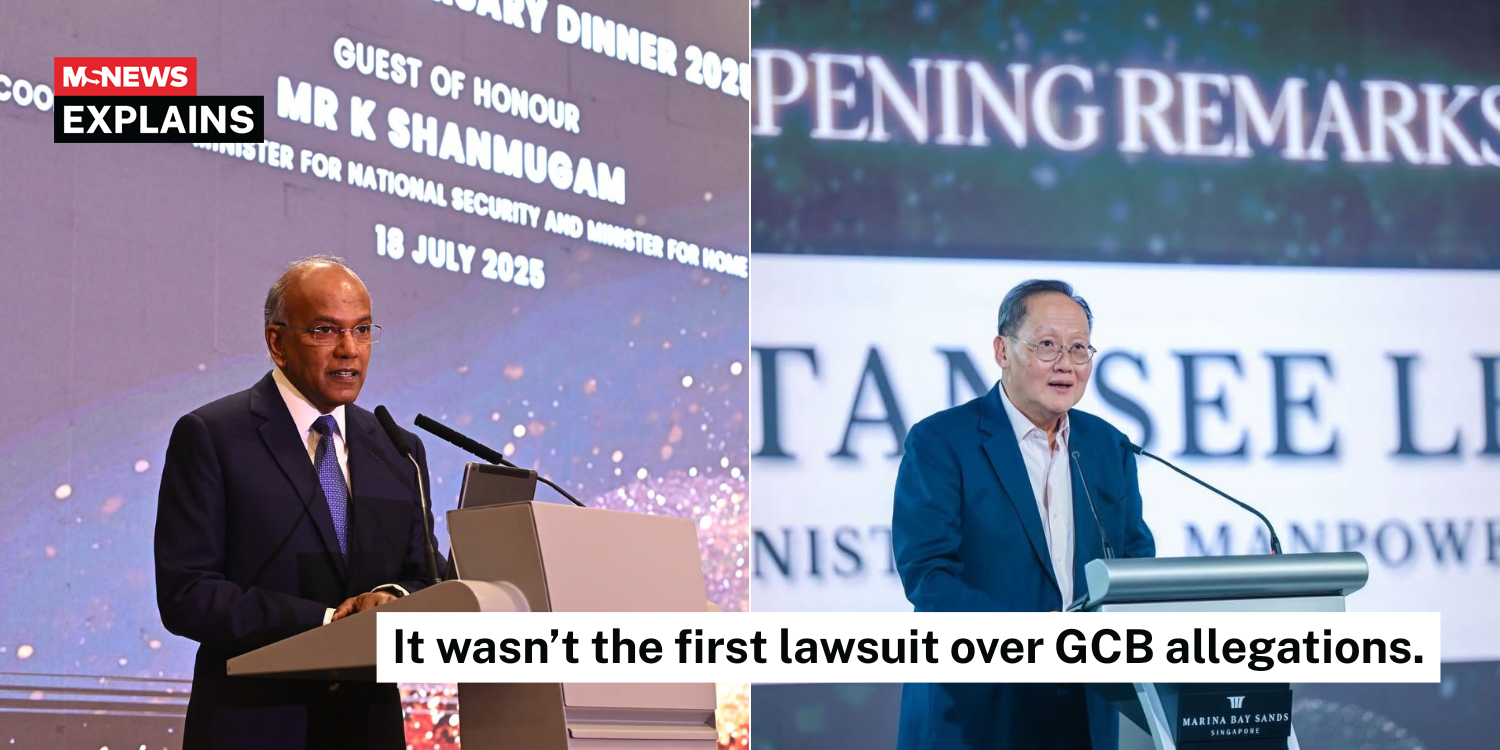

Why Shanmugam and Tan See Leng sued Bloomberg after TOC over the same GCB allegations
A property story.
Two Cabinet ministers.
One of the world’s biggest financial news organisations.
What started as a report on Singapore’s Good Class Bungalow (GCB) market has ended with Bloomberg and its reporter being ordered to pay a total of S$460,000 in damages after the High Court found the article defamed Home Affairs Minister K. Shanmugam and Manpower Minister Tan See Leng.
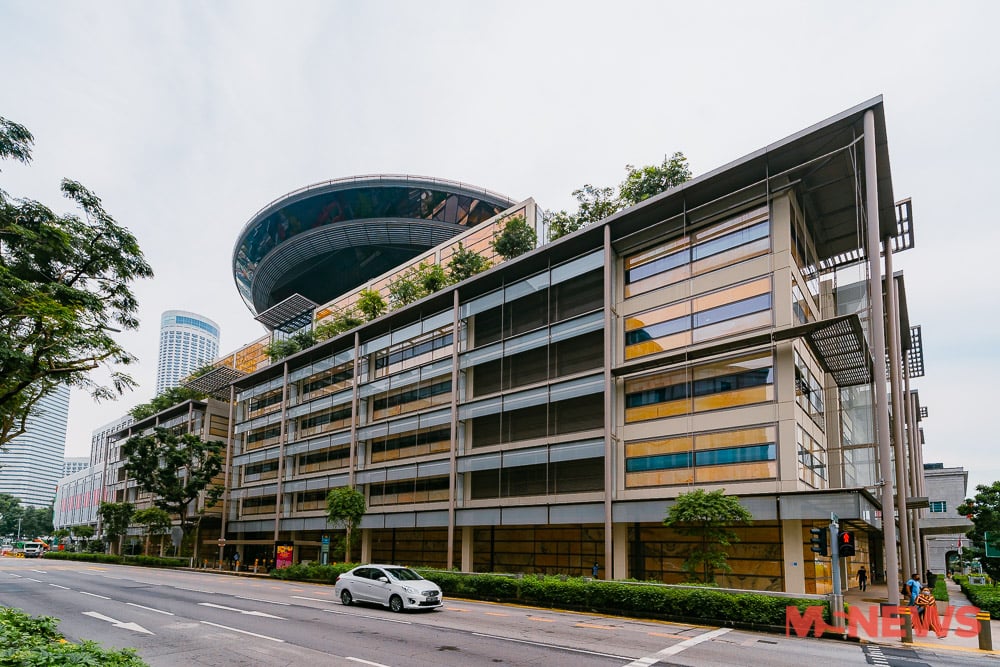
It’s also the second major lawsuit over the same GCB allegations this year.
So why have Singapore’s courts repeatedly ruled against these publications? And why did Bloomberg end up paying even more?
It wasn’t about what Bloomberg outrightly reported on
The answer goes beyond the dollar figure. It also explains why the two ministers chose to sue in the first place, despite later announcing they would donate the damages awarded to them — S$230,000 each — to charity.
In a judgement text, the High Court concluded that Bloomberg’s report crossed the line from reporting on a matter of public interest into defamation, finding that it left readers with the false impression that the ministers had deliberately kept their multimillion-dollar property transactions hidden from scrutiny.
One of the biggest misconceptions surrounding the case is that Bloomberg never explicitly accused the ministers of wrongdoing.
That much is true.
The article never directly alleged that either minister had committed money laundering or acted illegally.
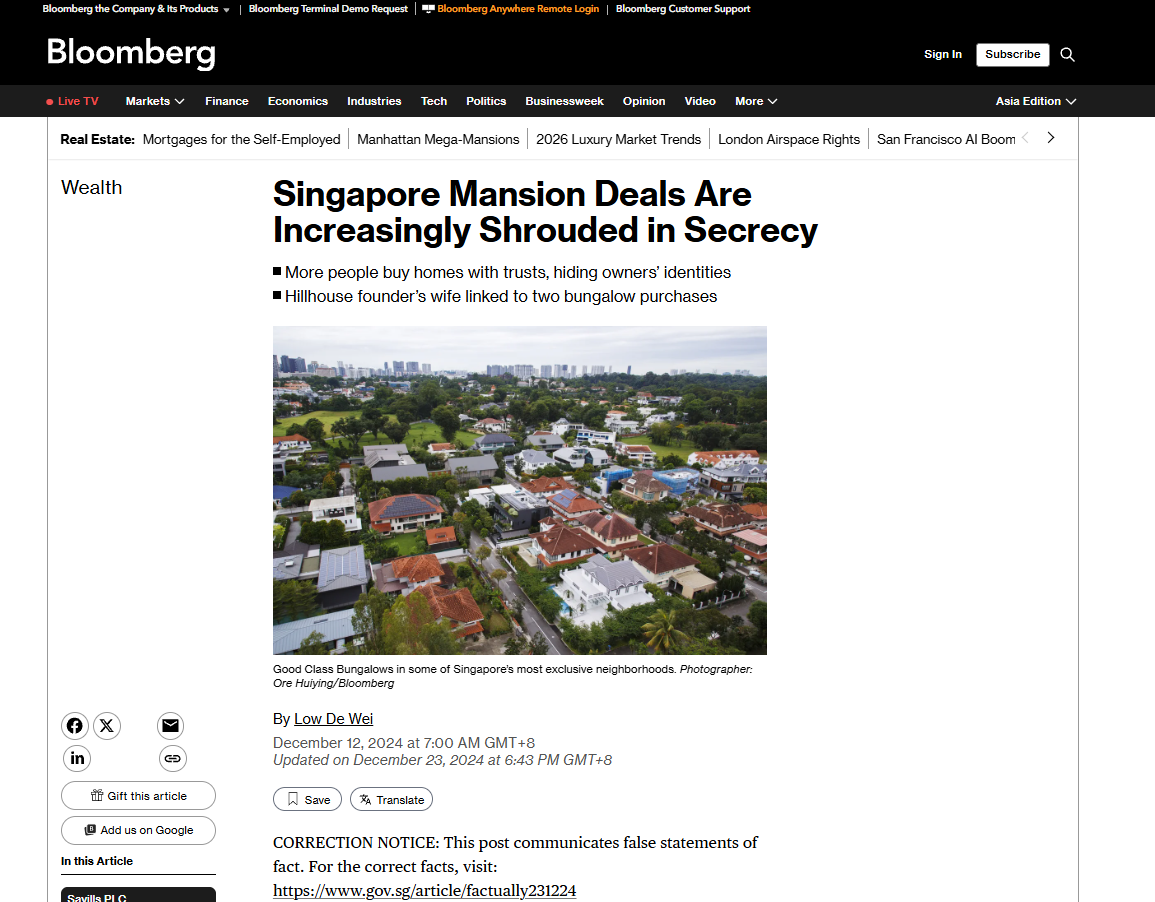
Source: Bloomberg website
But Justice Audrey Lim said that isn’t how courts determine whether something is defamatory.
Instead, the law looks at the overall impression that an ordinary reader would take away after reading the article as a whole, rather than analysing each sentence in isolation.
After examining the report, she found that readers would likely understand it to mean that Mr Shanmugam and Dr Tan had deliberately used shortcomings in Singapore’s property disclosure system to keep their GCB transactions out of public view and avoid scrutiny, including scrutiny over possible money laundering.
Such an allegation, the judge said, would plainly damage their reputations.

Source: Tan See Leng on Facebook
The court said the ministers weren’t just examples
Bloomberg argued that its report examined a broader trend involving non-caveated GCB transactions, with the ministers’ property deals serving merely as examples.
Justice Lim disagreed.
After reviewing internal editorial discussions, she found that the ministers’ transactions were central to the development of the story rather than incidental references.
The article repeatedly discussed secrecy, hidden transactions and concerns over money laundering before and around the sections mentioning the ministers’ purchases and sales, creating an association that the court found defamatory.
Source: James Cook University (Singapore Campus) on Facebook
Why did the ministers sue?
Following the judgment, both ministers stressed that the lawsuit was never about receiving money.
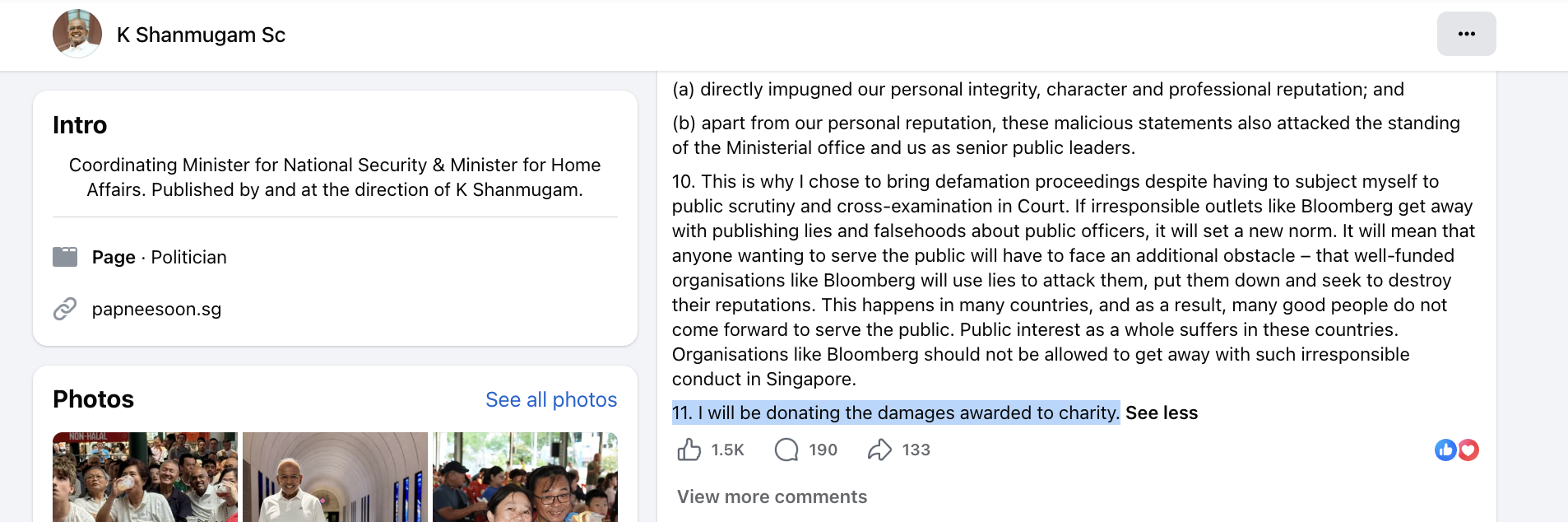
Source: K Shanmugam Sc on Facebook
In a Facebook post published on 14 July, Mr Shanmugam said the case was about protecting his integrity, reputation and the standing of his ministerial office after Bloomberg had published what the court found to be false and defamatory allegations.
He argued that if well-funded international organisations were allowed to publish falsehoods about public office holders without consequences, capable people might become reluctant to enter public service.
Dr Tan echoed the sentiment in a Facebook post published on the same day, saying public office holders should always remain open to scrutiny and legitimate criticism.
However, media reporting must also be fair and accurate, especially when allegations could seriously damage someone’s reputation.
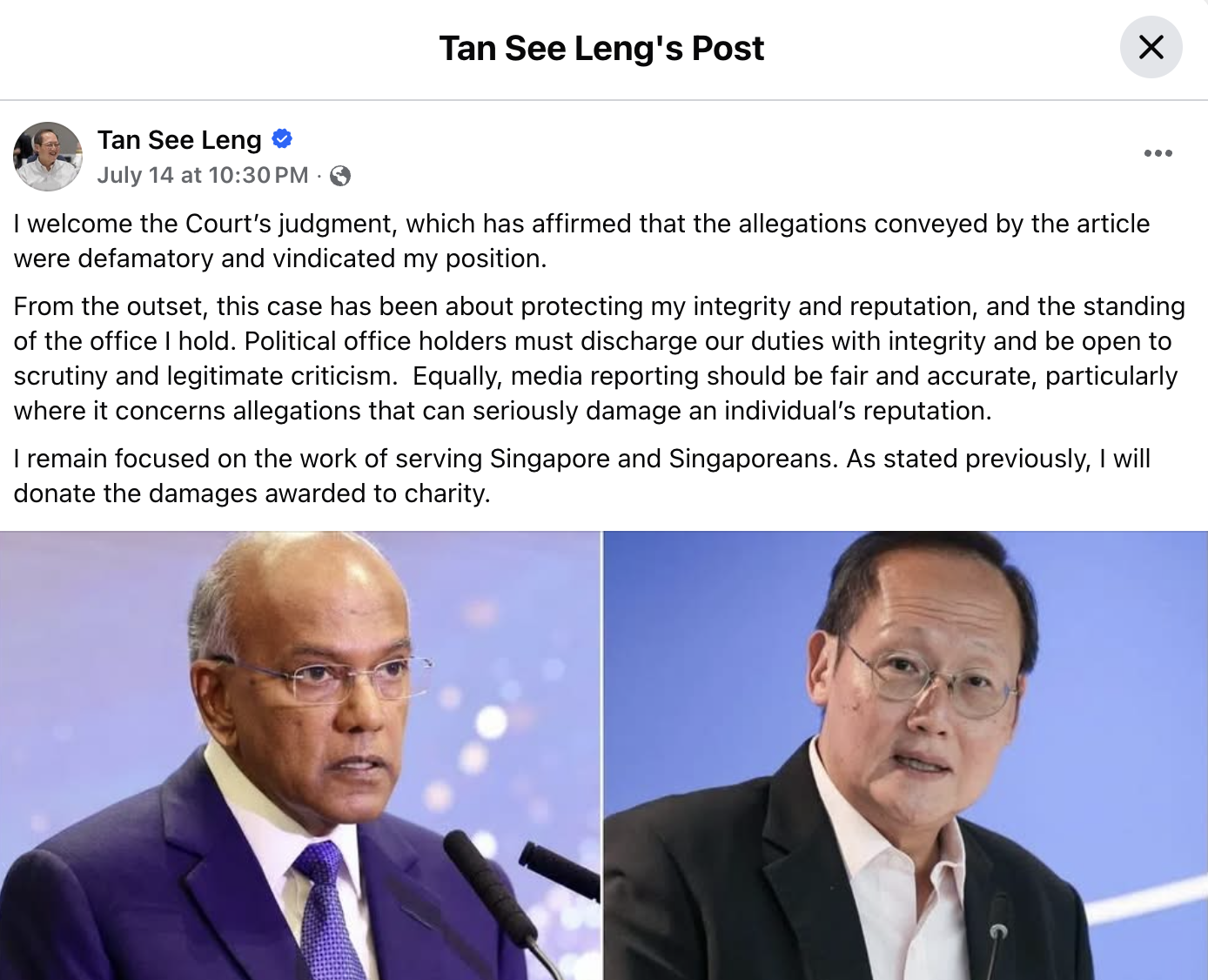
Source: Tan See Leng on Facebook
The High Court made a similar observation.
Justice Lim noted that the allegations struck not only at the ministers’ personal reputations but also their professional standing as Cabinet ministers, whose credibility and moral authority depend heavily on public trust.
It wasn’t the first lawsuit over the GCB allegations
The Bloomberg judgment followed another High Court decision delivered earlier this year.
In March, The Online Citizen (TOC) chief editor Terry Xu was ordered to pay S$210,000 to each minister after publishing an article that repeated similar allegations arising from Bloomberg’s reporting.
Unlike Bloomberg, Mr Xu did not contest the lawsuit.
Judgment was entered against him by default after he failed to file a notice indicating he intended to contest the claims, leaving the court to assess only the damages.
Justice Lim found that TOC’s article portrayed the ministers as being part of an opaque property system, exploiting legal mechanisms to keep their transactions secret and avoid public scrutiny, thereby suggesting they had acted improperly.

Source: The Online Citizen on Facebook
The judge also found that Mr Xu aggravated the harm by refusing to remove the article despite demands to do so, continuing to promote it across TOC’s website and social media platforms.
So why did Bloomberg have to pay more?
At first glance, the difference may not seem huge.
TOC was ordered to pay S$210,000 per minister.
Bloomberg must now pay S$230,000 per minister.
But the latest judgment explains why.
Justice Lim awarded each minister:
- S$170,000 in general damages
- S$60,000 in aggravated damages
This brings the total to S$230,000 each.
In deciding the amount, she considered several factors.
Among them were the seriousness of the allegations, the ministers’ positions as senior public office holders, Bloomberg’s international reach, and the publication’s conduct before and after publication.
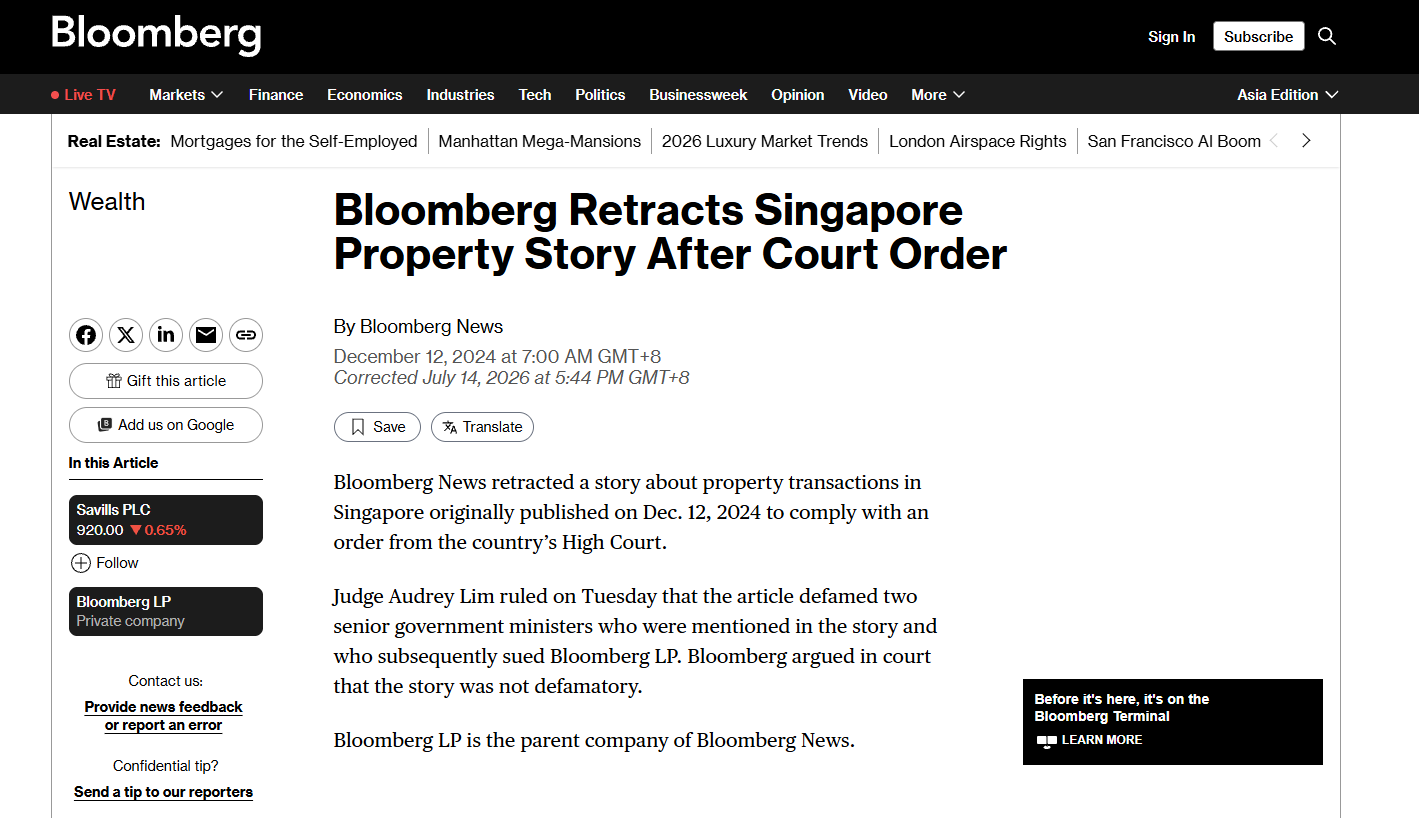
Source: Bloomberg website
What about Reynolds privilege?
Bloomberg argued its report concerned a matter of public interest and should therefore be protected.
Justice Lim rejected that argument.
She reiterated that the Reynolds privilege — a legal doctrine protecting some public-interest journalism under English law — has never been adopted in Singapore.
Even if it had been, she said Bloomberg would likely still have failed to meet the standard of responsible journalism.
Among other things, the allegations were serious, there was no urgency to publish, and the ministers were not given a fair opportunity to respond to the allegations that ultimately appeared in the article.
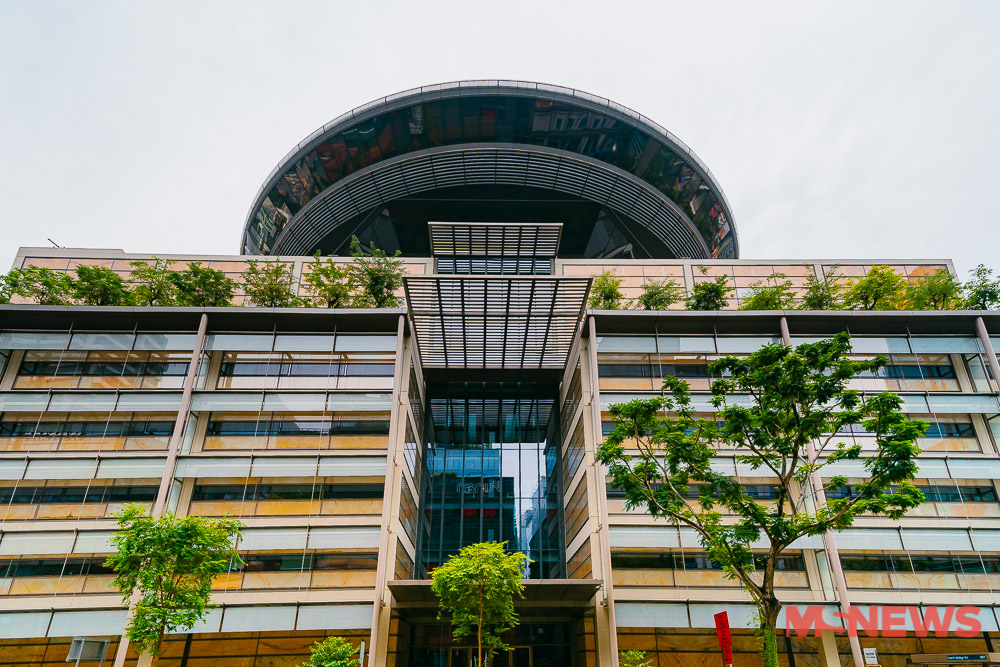
A case about more than property
On the surface, the dispute centred on two luxury property transactions.
But the judgments against both Bloomberg and TOC ultimately turned on something much broader.
The courts did not say journalists cannot report on ministers’ multimillion-dollar property dealings. On the contrary, those are matters of legitimate public interest.
Instead, the issue was whether the reporting falsely suggested that the ministers had deliberately concealed their transactions to avoid scrutiny, thereby undermining their integrity and the offices they hold.

Source: K Shanmugam Sc on Facebook
For Mr Shanmugam and Dr Tan, that was why they chose to sue.
“Some commentators, particularly in the Western media, say that defamation suits have a ‘chilling effect’,” Minister for Manpower Tan See Leng wrote in a Facebook post on 17 July. “But Singapore’s experience does not bear this out. Singapore supports robust journalism and vigorous public debate.”
“But freedom of expression carries responsibilities. It does not extend to publishing false and defamatory allegations without basis. That is the principle reaffirmed by the Court in this case.”
And although Mr Shanmugam and Dr Tan will not personally keep the S$460,000 awarded by the High Court, both ministers say the principle behind the lawsuits was always more important than the money.
Also read: Shanmugam & Tan See Leng awarded S$230K each over defamatory Bloomberg GCB story
Have news you must share? Get in touch with us via email at news@mustsharenews.com.
Featured image adapted from Cyber Security Agency on Facebook and Tan See Leng on Facebook.