
MS Speaks: The Mt Dukono tragedy deserves scrutiny, not cruelty disguised as seeking accountability
This piece is part of MS Speaks, a segment in which MS News reporters share their honest views on current affairs and trending topics. Views expressed in this article are the writer’s own and do not reflect those of the publication.
–
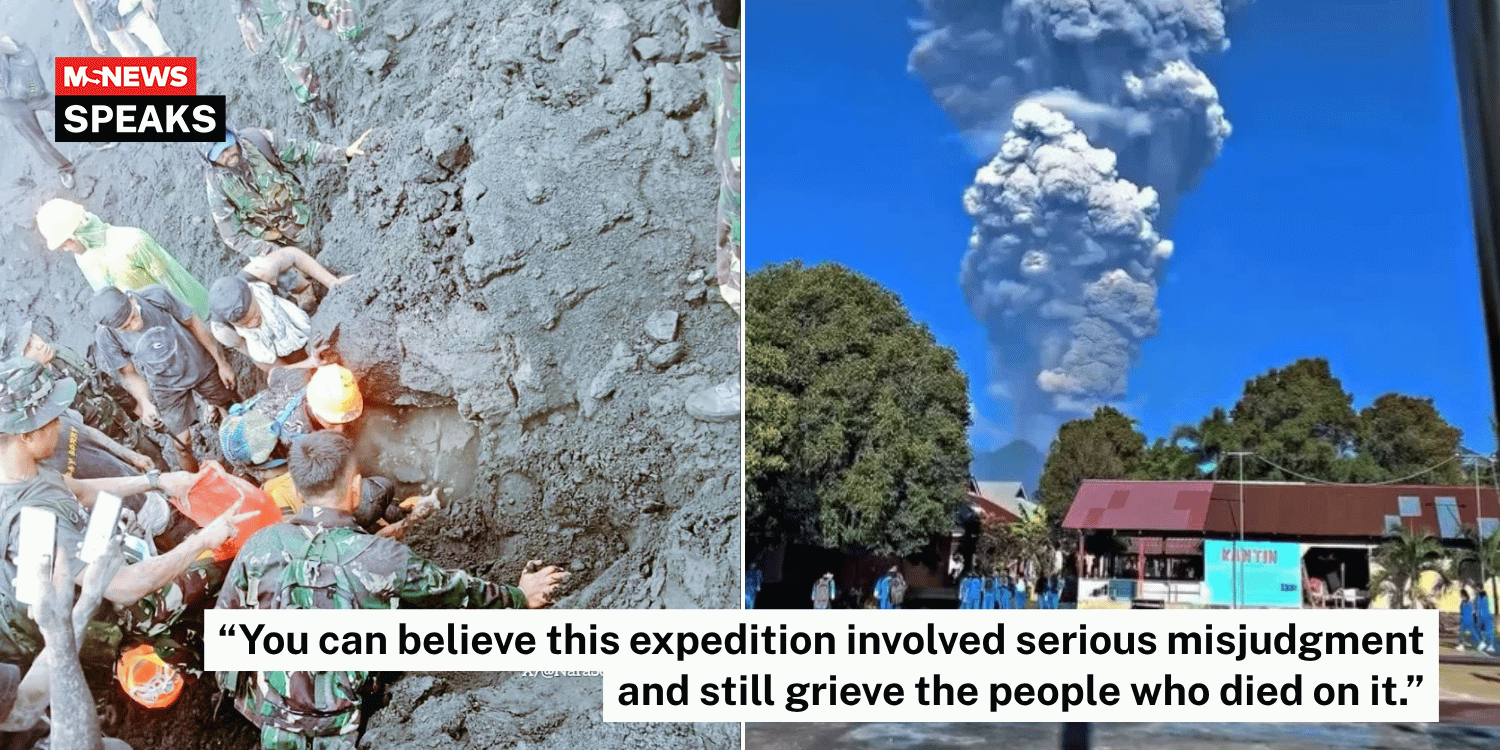
Mt Dukono has been erupting almost continuously since 1933. On 8 May, a group of Singaporean and Indonesian hikers climbed the volcano in North Maluku before dawn. At 7.41am, it erupted.
Three people died, including the 30-year-old Singaporean tour organiser Timothy Heng, who ran back toward the danger to help others.
The rescue operation stretched on for days. But before families had even been notified, the internet had already issued its sentence.

“He got what he deserves,” said this Redditor. Source: Reddit
What does it say about us that our first instinct, when someone dies doing something different, is to point and say, “serves you right”?
This piece is not about whether mistakes were made. Clearly, they were.
But there is a difference between accountability and satisfaction. And it’s unsettling when the first instinct, upon hearing about a person’s death, is to treat it like a moral fable with a deserved ending.
Turning tragedy into a lesson
When 10 Singaporean students and teachers died in Mt Kinabalu in 2015, online discourse quickly shifted toward whether schools should have sent children on such expeditions at all.
Never mind that seismologists described the quake as a freak event in a region with “very low historical seismicity”. Never mind that nobody could reasonably have predicted it.
The sentiment remained: this was avoidable; someone must be blamed.
A Straits Times (ST) forum letter at the time had to explicitly urge Singaporeans not to “cheapen the important work done by teachers by assigning blame to the blameless“.
While the earthquake was unforeseeable, the shaming was not.
The Mt Dukono tragedy is no different. Once reports emerged that the hikers may have ignored a climbing prohibition at the volcano, the internet locked onto a simple narrative: the trip was led by a reckless thrill-seeker courting danger.
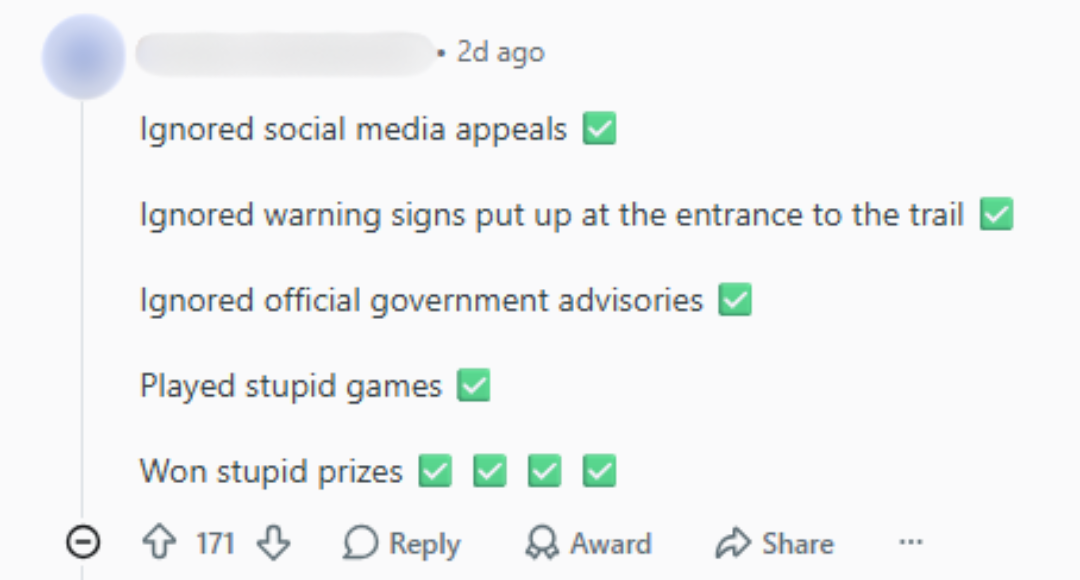
Source: Reddit
But the actual facts appear murkier than that. The local guide told the BBC he was unaware of any ban.
Villagers who regularly escort groups up the volcano allegedly said nothing either. There were safety gaps, and Indonesian authorities are still investigating what happened.
That still didn’t stop people from saying that the hikers looked for trouble — and found it.
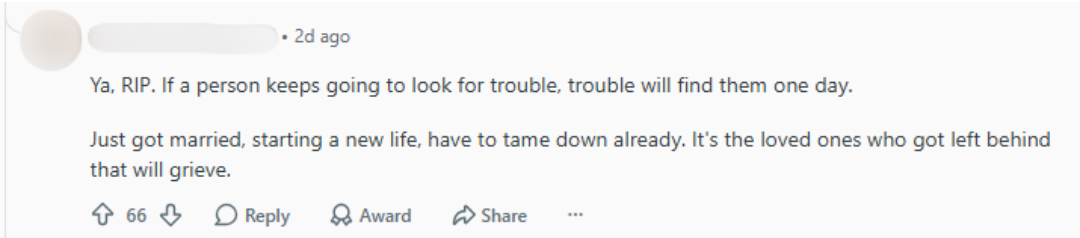
Source: Reddit
There is a name for this. Psychologists call it the Just World Hypothesis: the human need to believe the world is fair, that bad things happen to people because they made bad choices.
After all, if we believe that tragedy can strike randomly, then it can strike us too.
But if we convince ourselves that the deceased were arrogant, foolish, or irresponsible, then the world feels orderly again.
“I would never do that“, we tell ourselves. “Therefore, I am safe.”
A culture that treats risk as moral failure
This shaming didn’t come from nowhere. It comes from a society where people fear the unconventional, and treat risk as a moral failure.
The Hokkien word kiasi literally means “fear of death”. Culturally, we use it to mean risk-aversion and the unwillingness to venture into the unknown.
Looking at Singapore’s history, it makes sense: a small island with no natural resources and years of colonial trauma. Our survival had depended on pragmatism, discipline, and minimising mistakes. Back then, caution was an existential issue.
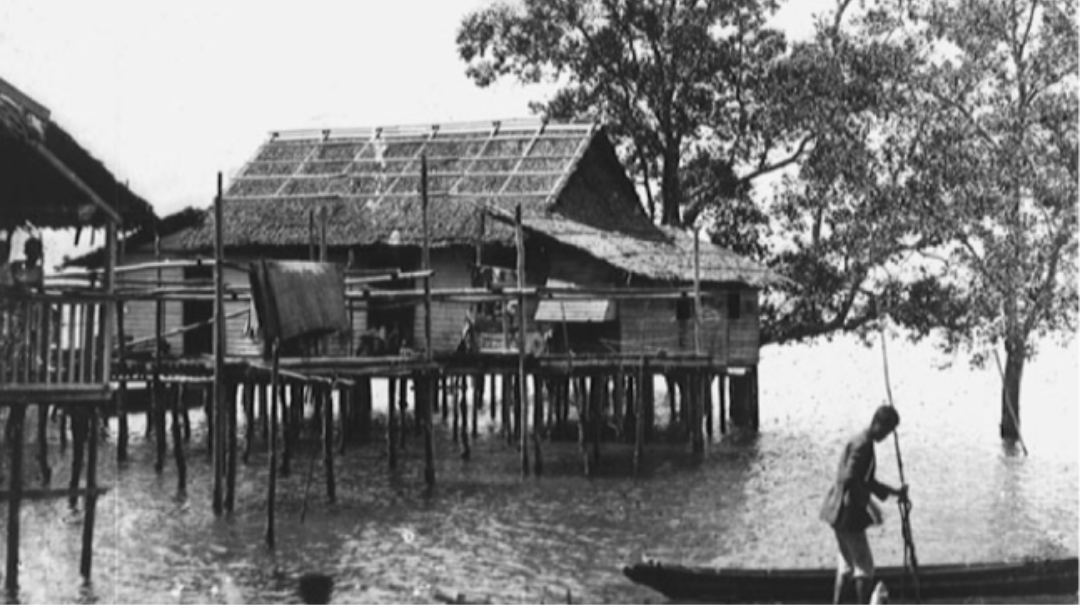
Singapore as a fishing village. Source: historyprojectswajam
And while it has contributed to the nation’s stability and order, that caution influenced a culture where someone who goes off the prescribed path doesn’t get sympathy when things go wrong. They get told they should have known better.
Seeing the public reaction to the recent tragedy, it feels as though Singapore’s relationship with risk feels moral rather than practical.
If failure is shameful, and risk invites failure, then risk is shameful.
If you take a risk and succeed, you’re visionary. If you fail, you’re irresponsible. Admiration is awarded retroactively, only after the outcome has already justified the gamble — and never for the dead.
Living in the court of public opinion
And you can see this cultural logic reinforced daily in peer surveillance.
Stomp built an empire out of citizens photographing each other committing minor social sins: eating on trains, putting bags on seats, wearing something strange in public.
The underlying message is: deviation is everybody’s business.
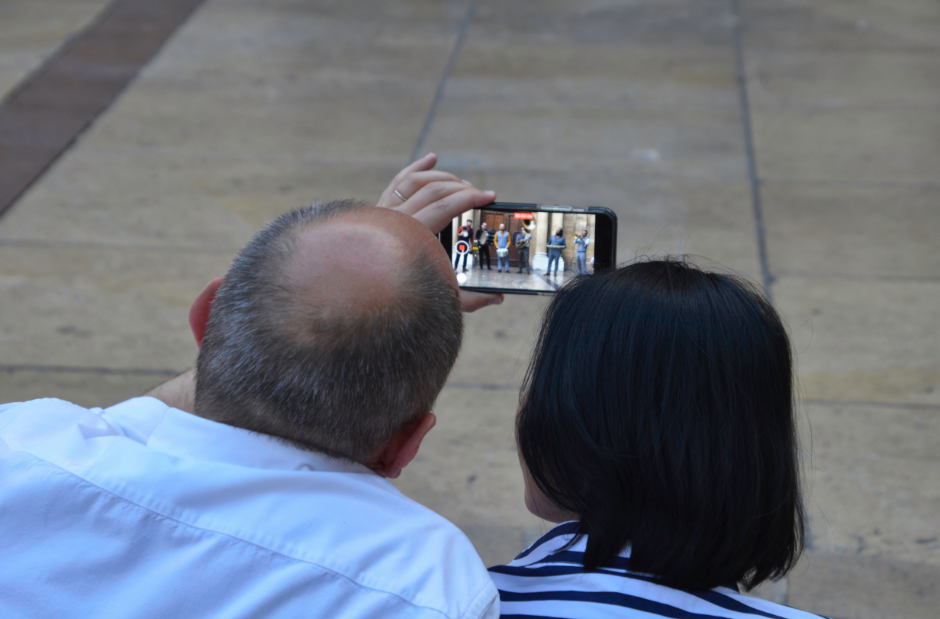
Source: lecreusois from Pixabay on Canva, for illustration purposes only
Sociologists describe Singapore as a “tight culture”, one where social norms are strongly enforced, and deviations are punished quickly.
Public shaming becomes a form of informal policing. A way to keep people in line.
Sometimes, that serves a purpose. But while social norms matter, applying the same punitive reflex to tragedy creates something grotesque.
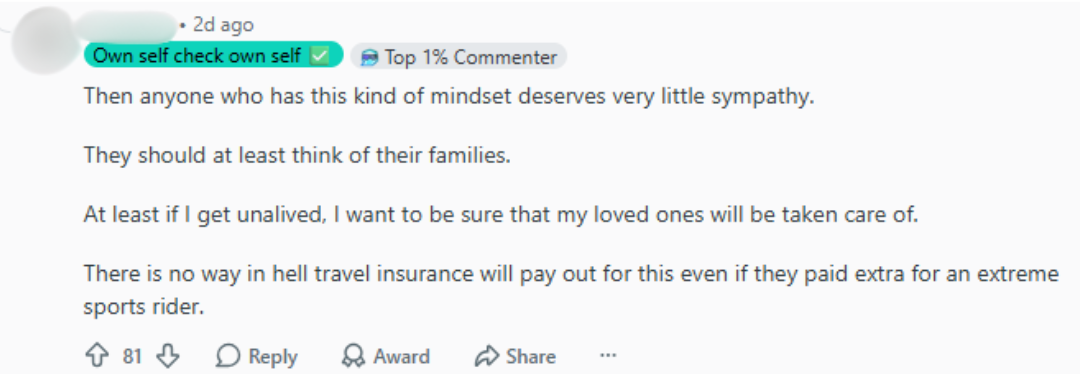
Source: Reddit
Timothy Heng is dead. He is not alive to learn a lesson from your Reddit comment.
So, who is the punishment really for? The answer is obvious: the rest of us.
Every “serves you right” comment is also a warning aimed at the living. Don’t take unnecessary risks. Don’t stray too far off-script. Don’t attempt things that sensible people wouldn’t.
Because if you fail, you can be sure that it will be entirely your fault.
When we shame the bold, we lose more than empathy
The inability to hold space for risk — and for the people who take it — isn’t just an empathy problem. It’s an innovation problem.
Singapore has acknowledged for years that risk-aversion is an issue to be tackled.
There have been calls for innovators, founders, artists, adventurers, people willing to think differently. Government speeches constantly stress the need for innovation and entrepreneurship.
Yet culturally, we remain deeply intolerant of failure, uncertainty, and unconventional behaviour.
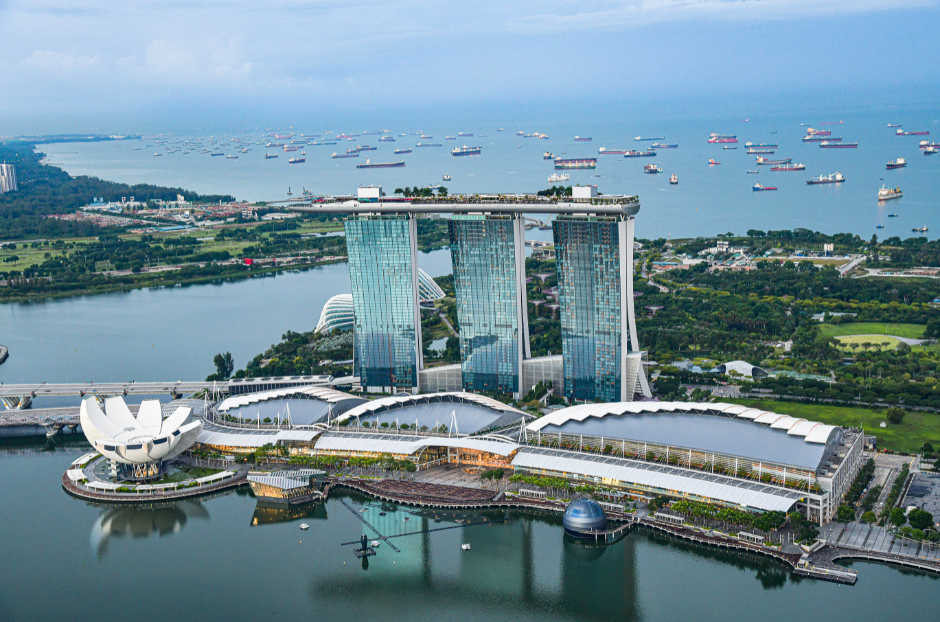
Singapore now. Source: Ravish Maqsood from Pexes on Canva
The Global Innovation Index ranks Singapore fifth globally, but researchers consistently find a gap between national-level performance and individual-level risk tolerance.
Even Apple co-founder Steve Wozniak once criticised Singapore for being too structured and conformist, asking: “Where are the creative people?”
It’s an uncomfortable question because we already know the answer. Creative people require room to fail publicly without being socially annihilated for it.
Timothy Heng was, in his own way, doing something Singaporeans are encouraged to do more of: go off the beaten path, follow curiosity, build a community around it, and seek experiences beyond the mainstream.
Did he underestimate the danger? Possibly. Were mistakes made? Clearly. But the impulse itself — the desire to go further, see stranger things, experience something raw and unfamiliar — is not a moral defect.
It has only been framed that way because the story ended badly.
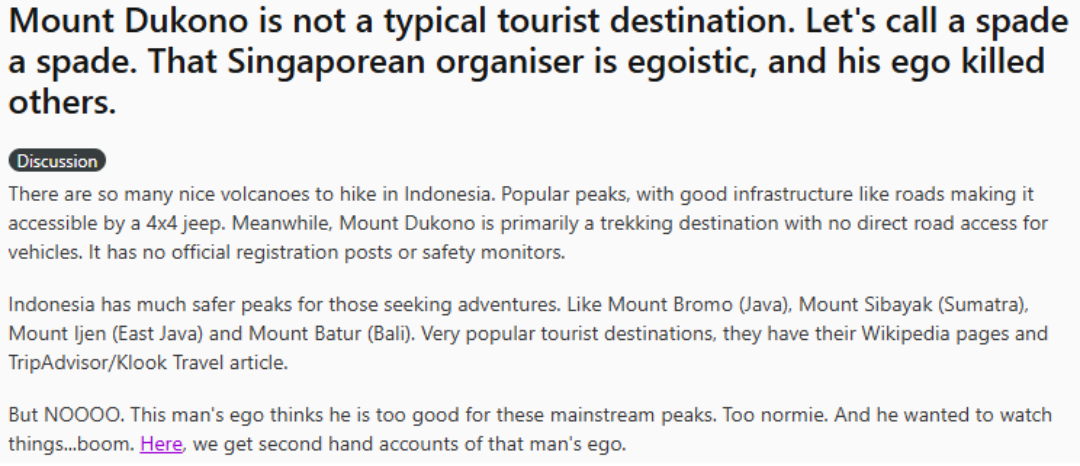
Source: Reddit
In another context, with a different outcome, it would have been a story about a Singaporean who dared to be different. It is only called “ego” in retrospect.
Accountability and grief are not mutually exclusive
And to be clear, this is not an argument against accountability.
Authorities should investigate whether safety protocols were ignored. Questions should absolutely be asked about how information was communicated to participants. If there was negligence, it should be addressed properly.
But accountability asks: how do we prevent this?
The “serves you right” comment asks nothing. It solves nothing. It only judges.

Source: Reddit
You can believe this expedition involved serious misjudgment and still grieve the people who died on it. You can ask hard questions about safety without reaching for satisfaction.
These truths can exist at once. They are not contradictions. They are what it looks like to maturely respond to tragedy — holding complexity instead of looking for a verdict.
What we lose when we shame people for trying
Singapore is, by many measures, one of the most successful societies in the world. Extraordinary things have been built through planning, discipline, and collective restraint.
But what does it say about our society when the knee-jerk response to tragedy is: who is to blame?
Are Singaporeans unempathetic? Not inherently.
But there now exists a culture where caution is coded as virtue, conformity as wisdom, and deviation, especially deviation that fails, invites not sympathy but condemnation.
We should investigate what went wrong on that mountain, and we should absolutely improve safety standards for independent travel groups.
But what we don’t have to do is greet the death of a 30-year-old hiker who ran back into danger to help his friends with the words: he got what he deserved.
The problem with a society obsessed with avoiding failure is that it eventually begins to treat it as a moral failing.
And when a society shames boldness into silence, it doesn’t just lose empathy. It loses the thing it claims to want most: the imagination to do things differently.
Read more: 2 S’porean hikers dead & 9 missing after Mount Dukono eruption in Indonesia
2 S’porean hikers dead & 9 missing after Mount Dukono eruption in Indonesia
Have news you must share? Get in touch with us via email at news@mustsharenews.com.
Featured image adapted from @geotechwar on X and @tijabar on X