
‘Bomb’ found buried 3m underground at construction site in Hong Kong
A bomb alert brought a temporary halt to activities in the heart of Hong Kong’s Tsim Sha Tsui district on Tuesday (8 July), but it was later confirmed to be a false alarm.
The large object was discovered at about 12.10pm at a construction site along Mody Road, according to the South China Morning Post (SCMP).
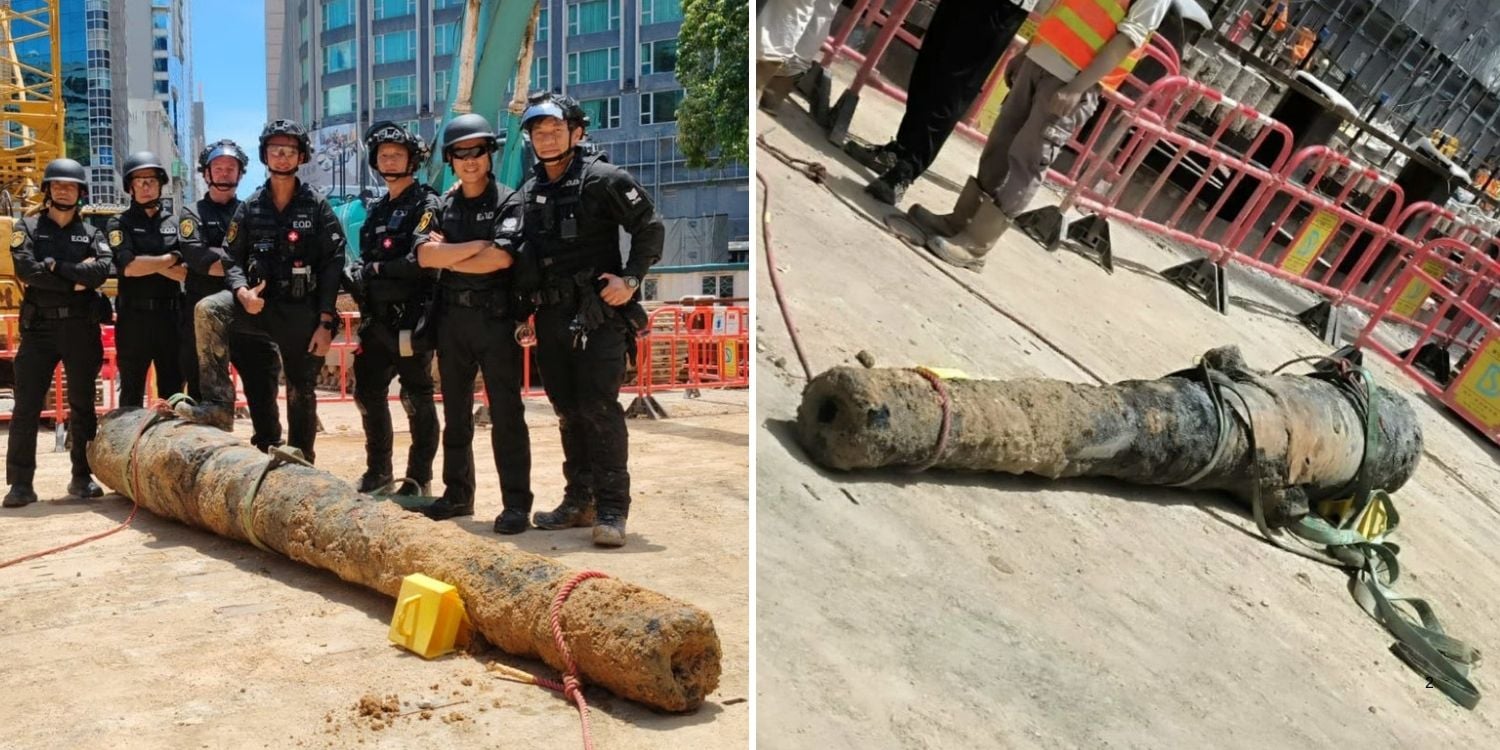
It was found buried 3m underground and was approximately 4mlong, with a diameter of 15cm.

Source: Hong Kong Police via China Daily Hong Kong on Facebook
Road in Hong Kong sealed off, bomb disposal called
As the object was suspected to be a bomb, the police were alerted.
They quickly sealed off a section of Granville Road, just outside the Hong Kong Science Museum.

Source: The Standard 英文虎報 on Facebook
About 40 construction workers were evacuated from the site as a precaution.
Officers from the Explosive Ordnance Disposal (EOD) unit were then deployed.

Source: The Standard 英文虎報 on Facebook
‘Bomb’ turns out to be British cannon barrel
After the object was examined by EOD, it was confirmed that it was not an explosive, but a British cannon barrel likely left behind from colonial times.
Thus, it was determined to be harmless.

Source: Hong Kong Police via China Daily Hong Kong on Facebook
A police source told the local media that the item was initially mistaken for a bomb due to its shape and the fact that it was found underground.
Road reopened more than two hours later
The sealed-off stretch of Granville Road was reopened more than two hours later, before 2.30pm.
According to Dim Sum Daily, a crane truck was used to transport the cannon barrel.

Source: Hong Kong Police via China Daily Hong Kong on Facebook
The authorities have not confirmed what would be done with the historical artefact.
Weapon likely abandoned after being decommissioned
Professor Kwong Chi-man, a military historian from the Hong Kong Baptist University, told SCMP that the weapon was a coastal defence gun commonly found in British defensive ports, believed to be either mounted on a coastal battery or aboard a naval vessel.
It probably wound up underground after being decommissioned and abandoned, he said.
While it was likely made in Britain in the late 19th century, he was uncertain when it arrived in Hong Kong.
However, he determined that it was not connected to World War II.
Also read: Multiple suspected explosives found in Phuket & Krabi, destroyed by Thai authorities
Multiple suspected explosives found in Phuket & Krabi, destroyed by Thai authorities
Have news you must share? Get in touch with us via email at news@mustsharenews.com.
Featured image adapted from Hong Kong Police via China Daily Hong Kong on Facebook.