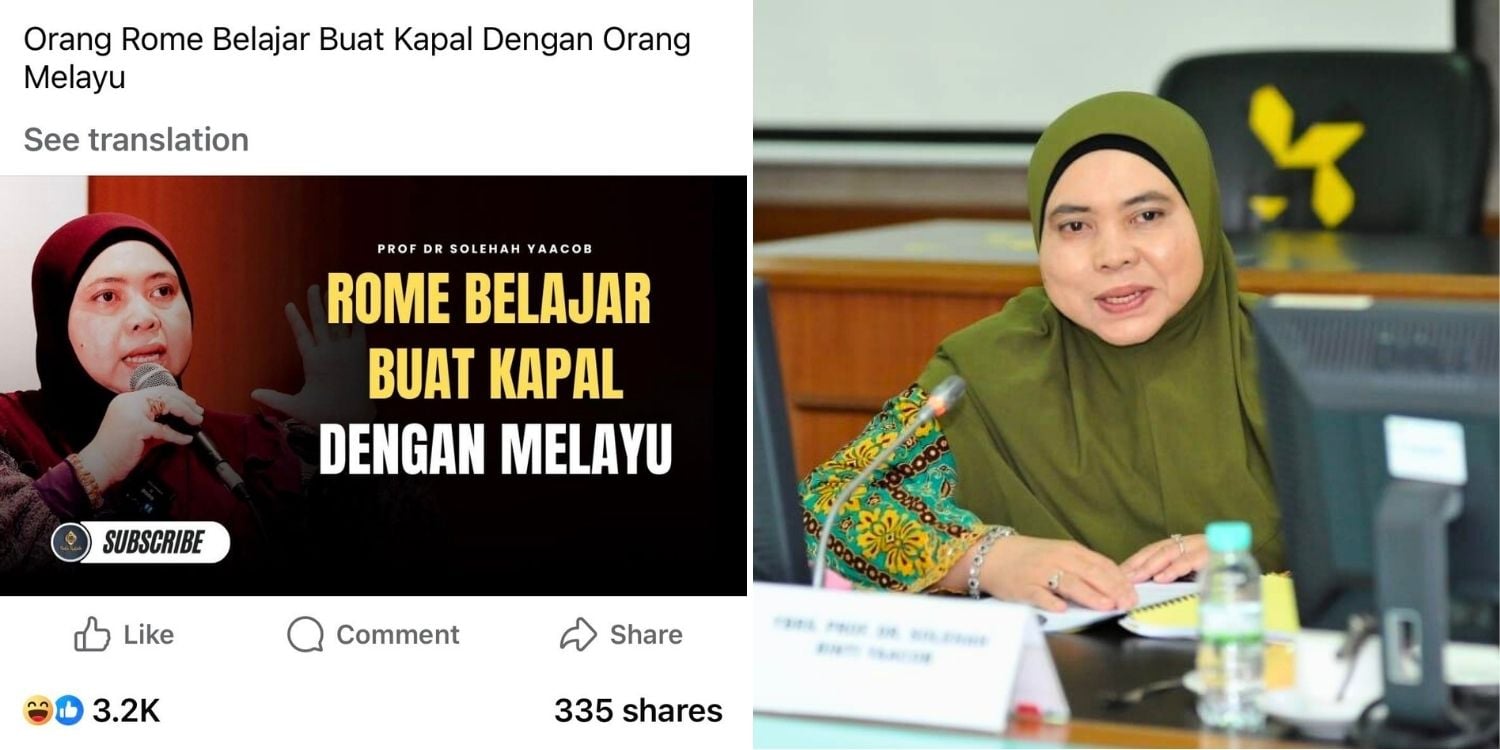

Malaysian lecturer’s remark about Roman shipbuilding goes viral
A Malaysian academic’s remark that ancient Romans learnt shipbuilding from Malays has exploded into a heated debate, with some defending the idea as proof of Southeast Asia’s ancient roots — and others mocking the theory and dismissing it as pseudo-history.
In a statement addressing her “public lynching”, Associate Professor Solehah Yaacob from the International Islamic University Malaysia (IIUM) said she made the statement at Masjid Gombak Setia in Selangor on 31 Dec 2022.
A recording of her lecture was then uploaded on YouTube on 31 Oct 2025.
It has since gone viral, racking up thousands of views and drawing ridicule, disbelief, and even counterarguments online.
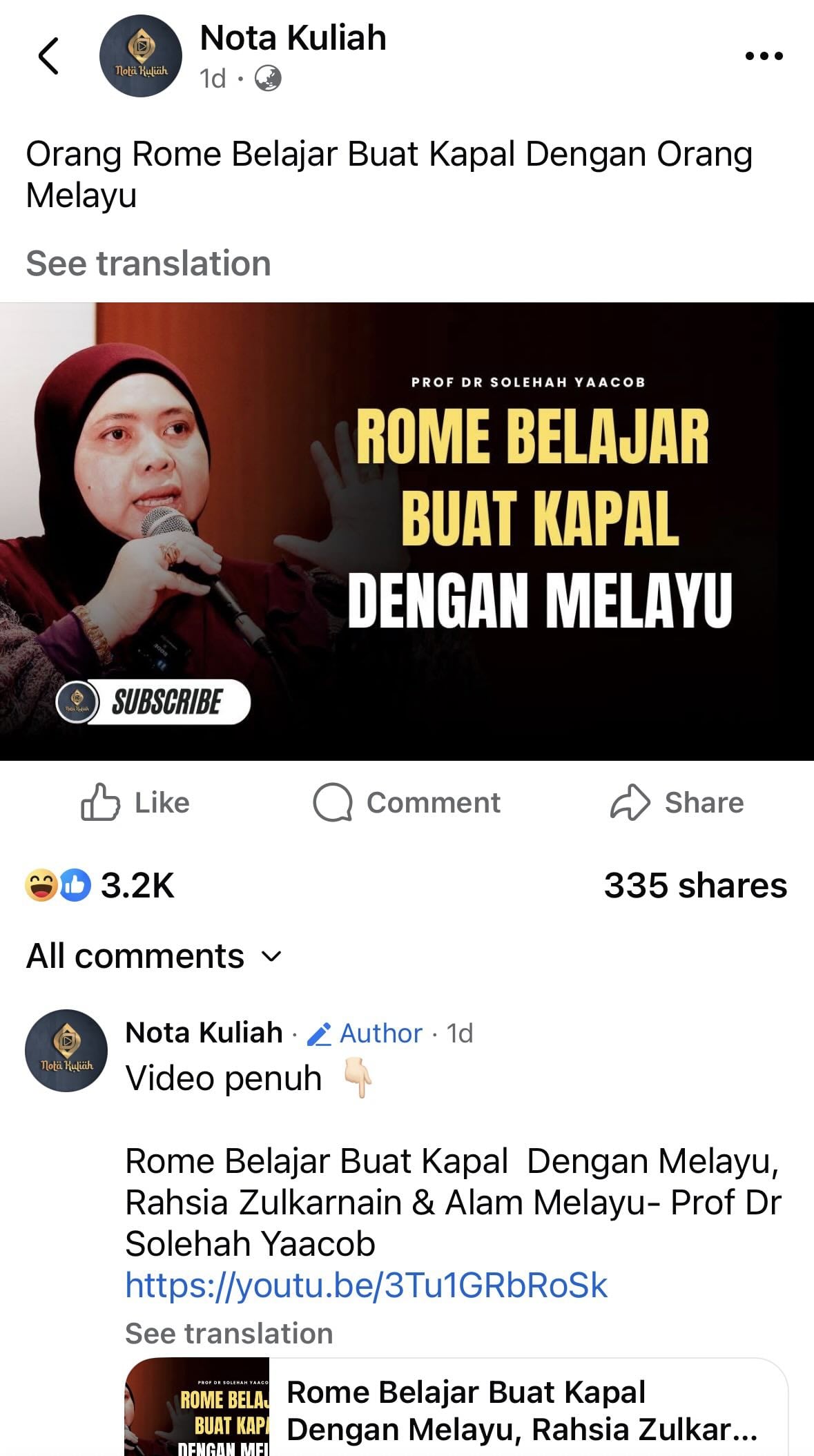
Source: creativebas on Threads
‘Let’s not turn history into fantasy’: Netizens
According to The Rakyat Post (TRP), in her presentation, Prof Solehah argued that the Romans might have learned shipbuilding techniques from Malay seafarers.
She said that these Malay seafarers were part of an advanced civilisation long before Europe’s maritime rise.
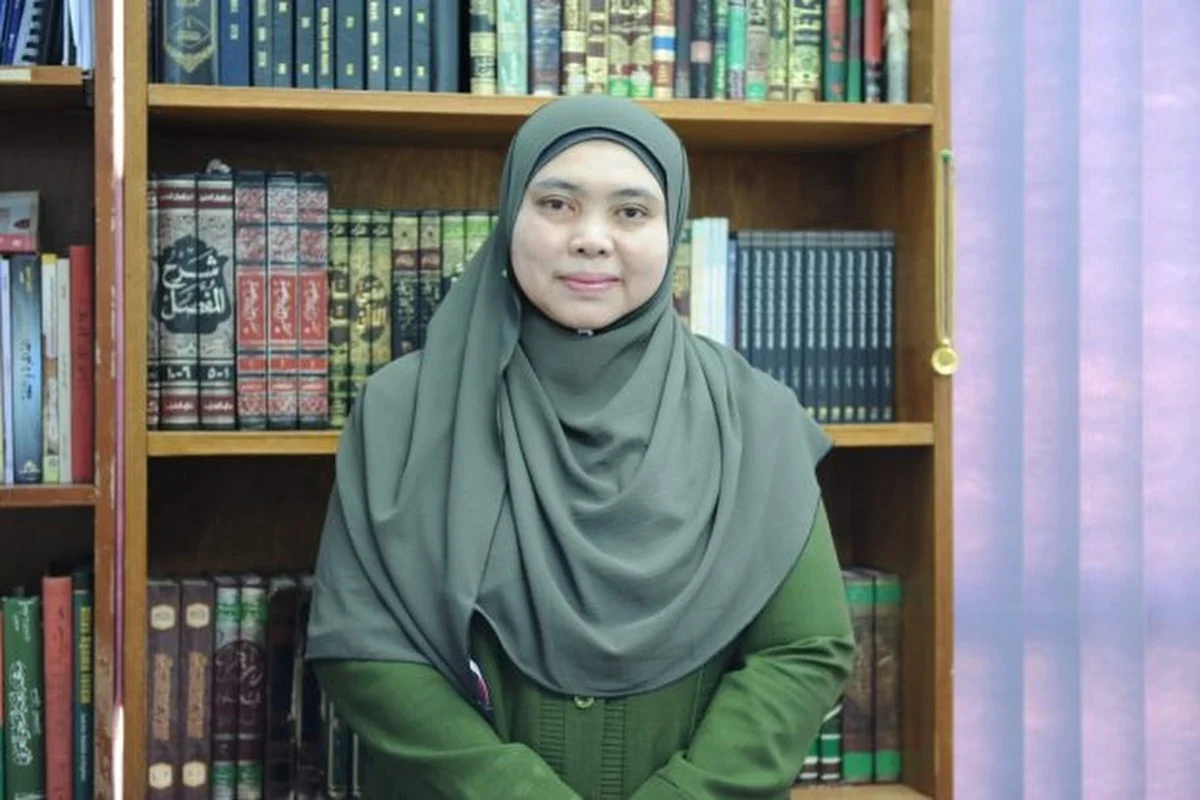
Source: South China Morning Post
However, not all netizens were convinced, with some pointing out some major flaws.
“We can be proud of Srivijaya and Nusantara sailors, but let’s not turn history into fantasy,” wrote another netizen.
Still, a handful defended the professor, saying her lecture was meant to celebrate Malay maritime heritage, not rewrite history.
Prof Solehah has since stuck to her claim, stating that her theory is based on “classical Arabic sources”.
“Unlike the Europeans, who were largely continental, the Malays were a maritime civilisation,” she wrote.
“I firmly believe that… the Romans learned navigational skills from earlier seafaring civilisations.”
IIUM distances itself from lecturer’s viral shipbuilding claim
Meanwhile, the university “distances itself” from the claim.
A statement by the IIUM Communications, Advocacy and Promotion Office (OCAP) said that the university is aware of the video circulating online.
They added that these actions have affected the academic integrity and image of the university as a reputable scientific institution.
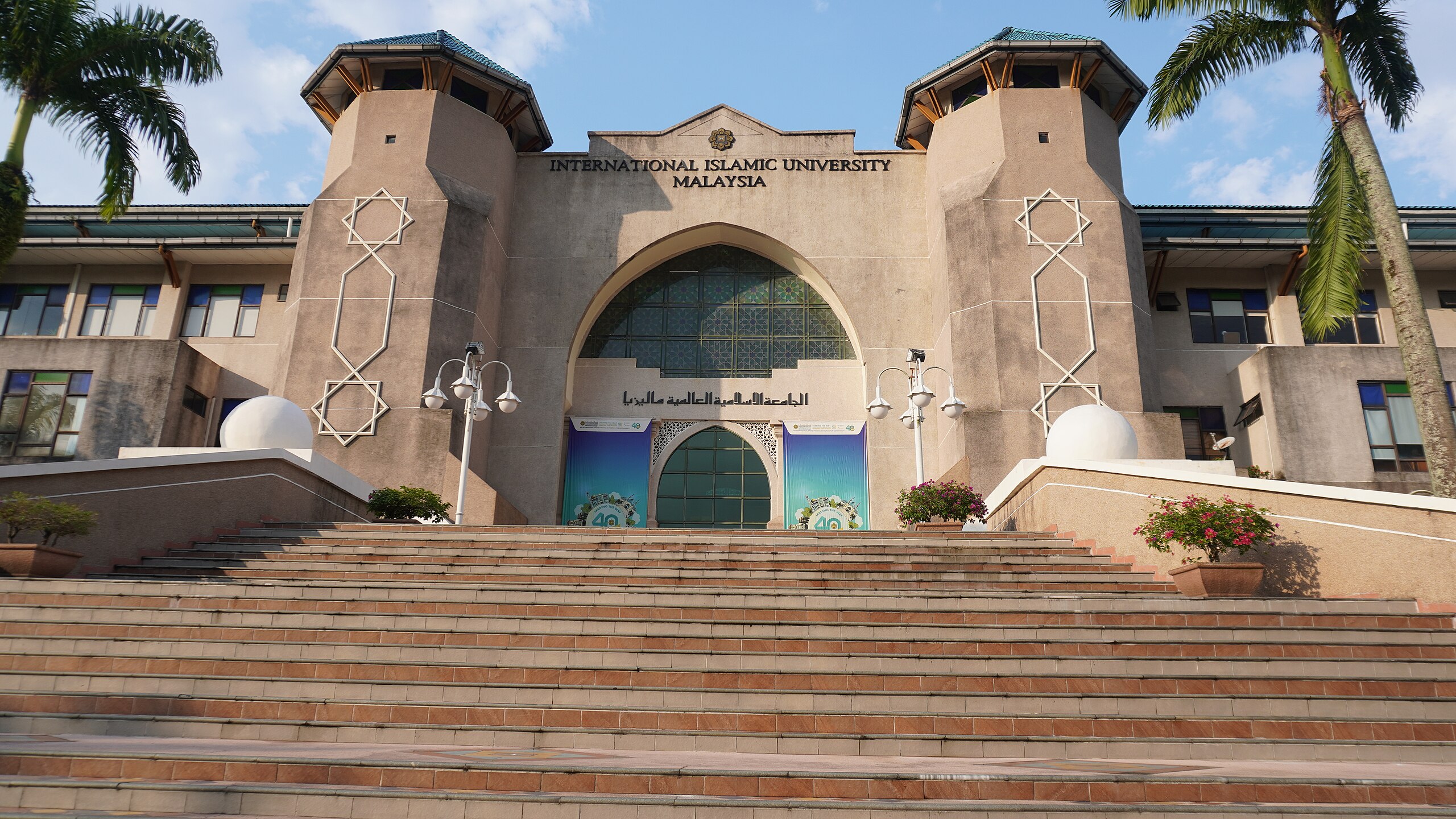
Source: Scoop Malaysia
“IIUM would like to emphasise that the views and statements made by the academic are personal and do not represent the official stance of IIUM,” the statement said.
“IIUM upholds the principle of academic freedom, allowing scholars to express their views and contribute to scholarly discourse, but such freedom must be exercised responsibly and grounded in academic accuracy.”
Academics and lawmakers weigh in
Addressing the situation, Malaysia’s Higher Education Minister Datuk Seri Dr Zambry Abd Kadir said that academics should refrain from making claims outside of their field of expertise.
“They should focus on their own areas of specialisation,” he said.
According to her staff profile on the IIUM website, Prof Solehah specialises in Arabic Linguistics, Language, and Literature.
Meanwhile, Professor Emeritus Wan Ramli Wan Daud, a historian of Malay technology from Universiti Kebangsaan Malaysia, has said that any similarities between Malay and Roman shipbuilding methods are coincidental.
There is reportedly no historical record or archaeological evidence of knowledge transfer between the two civilisations.
Professor Emeritus Wan Ramli further noted that other civilisations, such as the Vikings, also used similar shipbuilding methods.
Other academics have also stated that such pseudo-historical statements may undermine the credibility of the sector.
On 10 Nov, the debate even reached Malaysian parliament — with some urging for action from the National Unity Ministry.
Have news you must share? Get in touch with us via email at news@mustsharenews.com.
Featured image adapted from creativebas on Threads and Solehah Yaacob on Facebook.