MS Polls: Most say foreigners should be assessed on their English before getting PR status
From 2020 to 2024, Singapore has seen an average intake of 33,000 new Permanent Residents (PRs) per year, as well as 21,300 new citizens every year.
The matter of their assimilation has entered public discourse once more via a post by Bertha Henson, a former editor for The Straits Times.
In late January, she posited that immigrants should take a basic English test before being allowed to settle in Singapore, recounting an incident where a China-born stall owner berated her for ordering in English instead of Mandarin.

Image for illustration purposes only
Henson then told the woman that she should be one speaking English — and she isn’t alone in her sentiments.
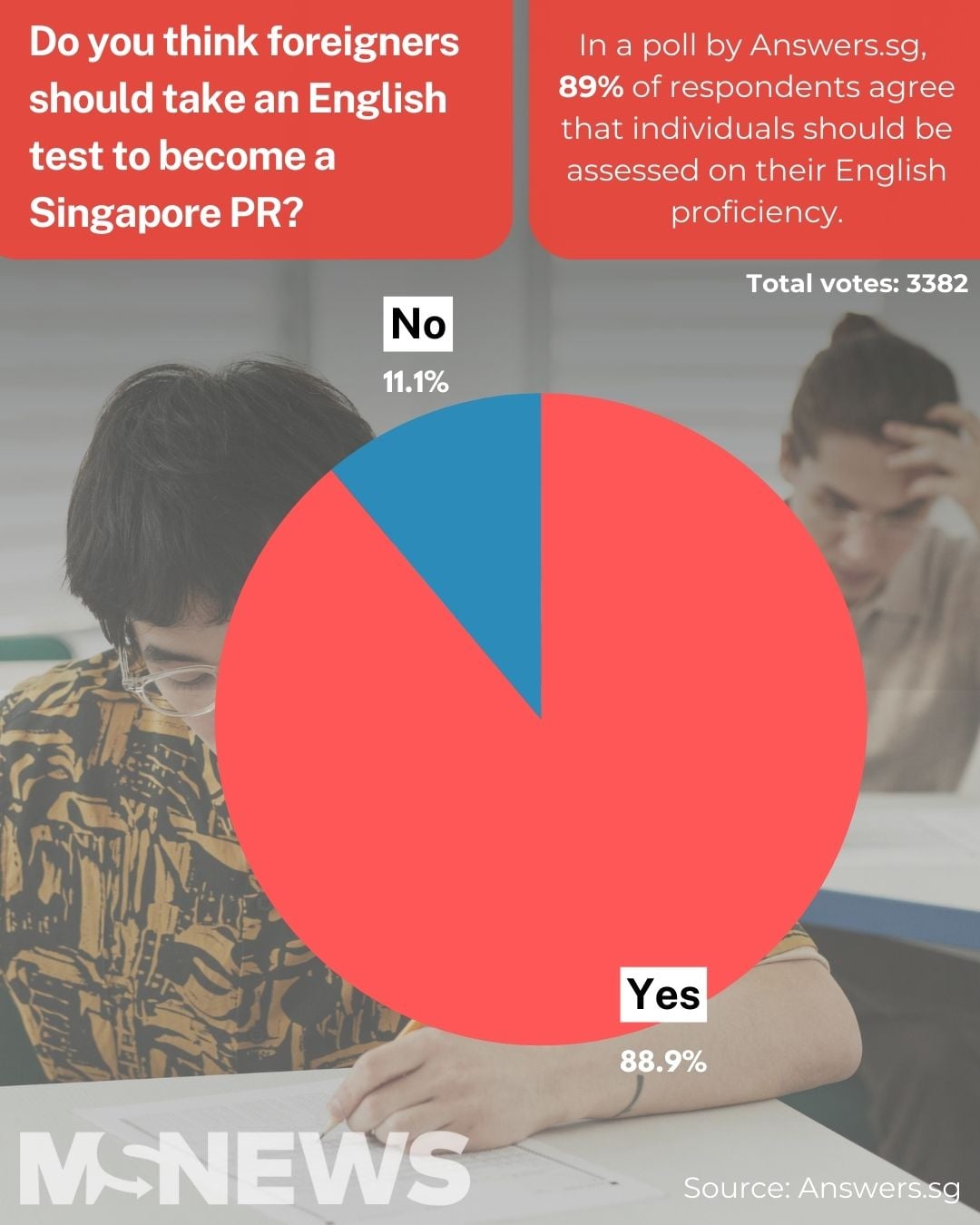
In a poll conducted by Answers.sg, 89% of 3,382 respondents agree that foreigners should undertake an English test to become a PR.
The case for implementing English tests
In her post, Henson suggested that while language proficiency should not be the sole criteria for PR or citizenship, it should be “part of a bigger set of criteria”.
“I personally feel that the ability to converse in basic or even ‘pasar’ [market] English should be a requirement for citizenship,” she said.
“Language is the best glue and English is the only language that cuts across the races.”

Image for illustration purposes only.
English tests would ensure that immigrants would be well-prepared for integration into society, as it is the de facto “common language”, serving as the language of choice for government proceedings and education.
Furthermore, it is the most frequently used language in nearly half of all Singaporean households.

Source: John T on Unsplash
Several Singaporeans MS News spoke to also shared more practical sentiments.
A trainee teacher, who prefers to be anonymous, said that knowing English is beneficial for a child’s assimilation and education.
Given that English is the main language of instruction in Singapore, a lack of understanding would hinder immigrant parents’ ability to assist children in their studies.

Image for illustration purposes only.
“It would make it hard for us to communicate with them about their children’s progress in school, which may in turn affect their studies,” she said.
“Even if they know just basic English, it would help teachers a lot in being able to communicate how best to help their children in terms of studies and school-related issues.”
English proficiency helps with workplace efficiency and accuracy
Having a basic knowledge of the English language may also be useful in boosting workplace efficiency.
This would ensure that instructions are not “lost in translation”, leading to lesser mistakes.

Source: Absolute Commercial Interiors
Clara, 23, a nurse, told MS News that given the shortage of hospital staff in Singapore, it is common for jobs to be outsourced to foreign nationals.
While they are equipped with the skills, she finds it hard to communicate with several of them due to their poor command of the English language.
As such, there may be situations where instructions are misunderstood, which may then affect the quality of care provided to patients.

Source: Akram Huseyn on Unsplash
Hence, she believes that a basic English test for immigrants would ensure “effective communication”, further noting that “most, if not all of our communication, case notes, and instructions are in English”.
Pushback from several key members of Parliament
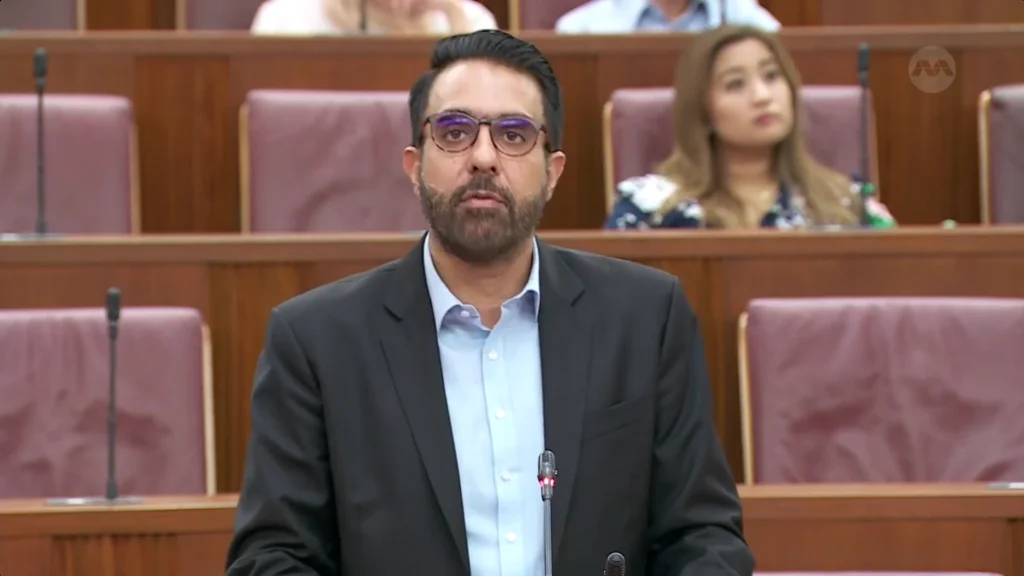
However, despite former Leader of Opposition Pritam Singh’s calls to include English tests in the criteria for new immigrants, these were quickly shut down by multiple ministers.
Source: MDDI on YouTube
Josephine Teo, the current Minister for Digital Development and Information, questioned how foreign spouses — who make up a significant portion of applicants who may struggle with English — would cope with such a requirement.
Meanwhile, Edwin Tong, the Minister for Law, stressed that language should not be the sole criterion for citizenship.
An unnecessary addition, not an immediate need
Some Singaporeans MS News spoke to also felt that the basic English tests were unnecessary and “over-the-top”.
They argue that while the knowledge of basic English would be a plus, it should not be a necessity.
For Annie, 54, a clinic assistant, the main criteria should be whether “they can contribute to Singapore in some way, be it economically or other means”.
“I don’t see why they have to pick up the language prior to immigrating,” she added.
Source: Wikimedia Commons
Annie believes that “they will eventually pick up bits and pieces of communicating in English while living in Singapore”.
Others pointed out that implementing such a test could disproportionately affect certain groups, such as elderly applicants or foreign spouses, and questioned how “basic English” would be defined.
A civil servant who requested to remain anonymous told MS News that such tests may also have feasibility issues.

Source: Expatis
“If it’s a written test, there’s the possibility of those who have taken the test before to share answers,” he claimed.
“And if you constantly change the test, some may question its consistency and credibility.”
Integration goes beyond language
Despite many claiming that the implementation of an English test may allow for better integration, some pointed out that integration involves more than just language ability.
Akmal, 26, a recent university graduate, pointed out that “people can speak fluent English, but also choose not to integrate into our multi-cultural society”.
He added that Singapore’s standing attracts numerous applicants, who may choose to move to Singapore for monetary, or quality of life reasons.

Source: HSBC
“It may not be the case for all immigrants, but I’m sure that some don’t see the need to integrate, they just want to reap the benefits of living in a safe and prosperous country,” he noted.
For Akmal, there is no reason to restrict potential immigrants based on their language ability, so long as they are able to contribute to the nation in their own way.
He cites the example of naturalised football players and table tennis players who have pulled their weight for Singapore in the past.

Source: Facebook
“It’s more like actions speak louder than words,” said Akmal.
“If they can prove their ability and contribute to the country then that’s good enough.”
Language and identity in a multi-racial society
Singapore recognises four official languages — English, Mandarin, Malay, and Tamil — though English functions as the working language across many sectors.
For some, requiring English proficiency from newer citizens reinforces the language’s role as a unifying bridge across racial groups.
For others, such a move may appear to elevate one language over others in a country that prides itself on multiculturalism.
After all, the Singapore pledge does state: “regardless of race, language or religion”.

Image by MS News, for illustration purposes only
Therein, the question lies: should language be treated as a marker of integration, or a practical communication tool?
While it seems as though the implementation of a basic English test will not happen any time soon, results from the poll suggest that public opinion still heavily leans towards it.
However, for now, this looks to remain a topic of contentious debate.
Have news you must share? Get in touch with us via email at news@mustsharenews.com.
Featured image adapted from Expatis for illustration purposes only.